It's been a while since I've been to the blog myself, because even though I think a lot about trash, recycling, and materialism; and even though I am still deeply influenced by the project, I haven't been living completely the way I did in Ann Arbor. Well, all of that changed pretty much overnight because a piece of mine--All my trash for a year fit into two plastic bags. Here’s how I did it.-- describing my experiences just got published in the Washington Post, which has given me a whole lot of food for thought. I can do more to live up to what I was doing in Ann Arbor. Or, perhaps, I start a new project to minimize entropy.
Thoughts? Ideas?
Thursday, October 29, 2015


Sunday, March 30, 2014
Four years on, reflections from a new home
On three previous occasions I have used this anniversary day to reflect on what I can do with my privilege and the tremendous resources I am surrounded by; to lessen my burden on the world; to continue a dialogue about the larger impacts of our individual choices, and the structural challenges we face in reshaping this culture of destruction, violence, and injustice into one aligned with peace, equality, and harmony; to make this dialogue actionable. Today is the fourth time I reflect on a small journey that began in my Ann Arbor kitchen, this time from a new home, Washington, DC.
As grey skies poured rain on my bus ride home from a weekend New York City today, I read a recent essay by Gretchen Legler in Orion, The Happiness Index: Putting people before profit in Bhutan. The essay describes Bhutan's alternative social, economic, and environmental metric, Gross National Happiness, in the context of the country's and people's struggles "negotiating the wilderness of modernization without losing its soul," a soul that has so far been filled with organic food and resided in lush, untouched environmental beauty, a soul being challenged by the opening of its borders and the cautious welcoming of what we call "modernization."
Sadly for Legler, she found in Bhutan a new found obsession with the modern world in which "traditions and nature are taking a backseat to convenience." For example, traditional, handcrafted bamboo food containers call bangchung replaced by "plastic insulated containers made in China, exported to Thailand, flown to India, and trucked over the southern borders."
After a three-day hike to to the holy lake Dragipangtsho, or "in the lap of the mountain," Legler and her group drink tea around a fire on the lake shore. She reflects:
"I begin to pick up trash and toss it into the fire," Legler writes. "Karma stops me in alarm: "No! You must not burn trash beside a holy lake! It will offend and anger the local deities."...[W]hile burning garbage beside a holy lake is taboo, leaving garbage as of yet seems to carry no spiritual repercussions. The incongruity of it hangs over us all."
I do not live trash or recycling free anymore, but I live a changed life because of this journey, because of where I live. Climate change resilience, low-cost air pollution sensors to fight for environmental justice, the politics of the Environmental Protection Agency, protests against the Keystone XL pipeline, anti-drone summits...my new home, this nation's capital, has provided new outlets for socioecological engagement, and alternative concepts and paradigms to think about, act on, build. I am fortunate to be here, and I am looking forward to what is next.
As grey skies poured rain on my bus ride home from a weekend New York City today, I read a recent essay by Gretchen Legler in Orion, The Happiness Index: Putting people before profit in Bhutan. The essay describes Bhutan's alternative social, economic, and environmental metric, Gross National Happiness, in the context of the country's and people's struggles "negotiating the wilderness of modernization without losing its soul," a soul that has so far been filled with organic food and resided in lush, untouched environmental beauty, a soul being challenged by the opening of its borders and the cautious welcoming of what we call "modernization."
Sadly for Legler, she found in Bhutan a new found obsession with the modern world in which "traditions and nature are taking a backseat to convenience." For example, traditional, handcrafted bamboo food containers call bangchung replaced by "plastic insulated containers made in China, exported to Thailand, flown to India, and trucked over the southern borders."
After a three-day hike to to the holy lake Dragipangtsho, or "in the lap of the mountain," Legler and her group drink tea around a fire on the lake shore. She reflects:
When we finally arrive at the holy lake, it is nearly night...But even with the fire and tea, this is a fierce place. Magnifying this eerie scene is that we are camped in what feels like a garbage dump, surrounded by piles of plastic litchi juice containers, candy and gum wrappers, packaging from dried noodle soups, clear plastic Bhutanese gin and vodka bottles, worn out trousers, a blue rubber boot.I stare outside the bus window along I-95, and see a congruent scene rushing by my eyes at seventy miles per hour: junk of all kinds littering the shore of the highway, the shore of forested lands. While many have benefited from a paradigm of environmental destruction, modern society's most boundless production is pollution, waste, and trash, refuse strewn across landscapes, leeching unwanted chemicals into our soil and water, ending up in living bodies, cancerous.
"I begin to pick up trash and toss it into the fire," Legler writes. "Karma stops me in alarm: "No! You must not burn trash beside a holy lake! It will offend and anger the local deities."...[W]hile burning garbage beside a holy lake is taboo, leaving garbage as of yet seems to carry no spiritual repercussions. The incongruity of it hangs over us all."
I do not live trash or recycling free anymore, but I live a changed life because of this journey, because of where I live. Climate change resilience, low-cost air pollution sensors to fight for environmental justice, the politics of the Environmental Protection Agency, protests against the Keystone XL pipeline, anti-drone summits...my new home, this nation's capital, has provided new outlets for socioecological engagement, and alternative concepts and paradigms to think about, act on, build. I am fortunate to be here, and I am looking forward to what is next.
Wednesday, March 26, 2014
How can we forget? Exxon Valdez and the Kirby Barge
"The struggle of man against power is the struggle of memory against forgetting," wrote Milan Kundera.
Many people remain blind to or unaware of the power that must be challenged if we are going to revolutionize our economic and political systems to align their interests with justice and ecological integrity. This is due partly because of a massive disinformation campaign by corporate and political elites, and partly because everything we do--heating our homes or transporting ourselves to work--is inextricably bound to these power structures that feed us toxic and dirty energy. If this energy is in everything, we do not have a choice. If we do not have a choice, we can slowly become blind to alternatives.
It is sadly fitting that on the 25th anniversary of the Exxon Valdez oil spill in Prince William Sound in Alaska, we are dealing with another ship-caused oil spill, this time in Houston and Galveston after a barge owned by Kirby Inland Marine Co. leaked bunker fuel into the Gulf of Mexico. While the size of the spill is sixty times smaller than Exxon Valdez spill (11 million gallons from the Valdez vs 170,000 gallons from the barge), the spill could not have come at a worse time for the birds that are migrating to and from the area. (News just in: We are also dealing with another oil spill in Lake Michigan. The culprit, BP.)
Just when we thought that we learned lessons from Exxon Valdez, that the BP Deepwater Horizon spill was fading into distant memory, just when politicians (and some scientists, and, maybe even the President) delusionally support of the Keystone XL pipeline by saying that its ecological effects are minimal or could be mitigated, we are presented with not one, but two oil spills. Perhaps this is a good thing. Perhaps
We need to use these events to keep ourselves and the masses from forgetting, from losing focus on the struggles that lie in every next step. We need to use these events to (re)orient ourselves to strategically challenge and fight the culprits of socioecological havoc and injustice of all kinds.
We cannot forget that challenging big oil means confronting hegemonic power. We must use these events, as Naomi Klein says, to make the increasingly popular calls for fundamental and systemic reform powerful.
Wednesday, March 5, 2014
The Keystone XL pipeline: Environment be damned
There is a ton of literature and information available about the ecological impacts of tar sands. These impacts stem from the entire spectrum of the tar sands process--from mining the sand, to extracting the unrefined bitumen oil, transporting the diluted bitumen (or "dilbit"), and refining the dilbit to be burned.
First and foremost, a vast expanse of tar sands, the source of the oil that the northern leg of the Keystone XL will be shipping, lies in one of the largest intact forest and wetland ecosystems in the world--the Canadian Boreal Forests. Currently, trees need to systematically cut down to gain access to the tar sands that lie beneath the ground. There is a significant amount of greenhouse gas emission that occurs from deforestation. (It does not really matter what the deforestation is for, greenhouse gases will be released.) Of the 767 sq. km of forest that has been destroyed over the past few decades, only 104 hectares has been "certified restored," i.e. only 0.13% of the land has been somehow restored to its "original" state, if that is possible. If the average age of black spruce is 200 years, and the average age of lodgepole pine is 150-200 years, and if it is likely that this is the average age of the trees cut down, how long will it take to actually restore the land the condition it was once in?
 |
| Boreal forest against a Suncor surface mine. The Apocalyptic Landscapes of Alberta's Oil Sands, from wired.com |
 |
| The yellow spots are the largest trucks in the world. The Apocalyptic Landscapes of Alberta's Oil Sands, from wired.com |
Secondly, one the trees are cut, the land below must be industrially excavated and large quantities of water used to extract the bitumen from the sands. According to the Canada National Energy Board, it takes between 2.5-4 barrels of water to extract one barrel of unrefined synthetic crude oil. This water is significantly contaminated and the water that isn't recycled is stored in tailing ponds that leak into local water supply. The Athabasca River is connected to the Peace-Athabasca Delta, one of the world's largest freshwater deltas. Estimates say that by 2020, around 1 billion cubic meters (the volume of 400,000 Olympic-sized swimming pools, or the entire area of around 11 Manhattan islands submerged to a depth of one meter) of toxic water will be stored in tailing ponds by Suncor and Syncrude alone.
 |
| A Suncor facility and tailing ponds alongside the Athabasca River. The Apocalyptic Landscapes of Alberta's Oil Sands, from wired.com |
 |
| Tailing ponds along side the Athabasca River, seen on the top left. The Apocalyptic Landscapes of Alberta's Oil Sands, from wired.com |
What is the potential for contamination and leakage of this water, let alone the fact that this water is essentially permanently toxic? Fish in Lake Athabasca, near Fort McMurray (an oil boom town), have unusual red spots on them, likely from the pollutants.
 |
| "Ronnie Campbell hauls whitefish from Lake Athabasca, downriver from Fort McMurray, to use as feed for his sled dogs. Locals say their catches are often covered in unusual red spots, and many no longer eat lake fish. While the cause of the spots is unclear, some believe toxic chemicals, such as those released during bitumen production, are leaching into Alberta's rivers and lakes." Peter Essick, National Geographic Magazine, 2009 |
Thirdly, the bitumen is viscous and dense. To transport it, it must first be diluted with diluents--other petroleum products--and then pumped at high temperatures and pressures. Dilbit is much more corrosive than other kinds of crude oil, and the likelihood of pipe leaks and eruptions thus increases. When the leak occurs in water, the diluents separate from the heavier bitumen, and the bitumen sinks to the bottom of the water body. This is exactly what happened in June 2010, just weeks after the Deepwater Horizon explosion occurred, when an Enbridge-owned pipe erupted and spilled more than a million gallons of dilbit into the Kalamazoo River. The technology to adeuqately deal with such a spill does not exist. Four years and a billion dollars later, 40 miles of the Kalamazoo river still remain contaminated. What might happen if the Keystone XL leaked (and its southern leg Keystone 1 has already...twelve times in its first year...more than any other first-year pipeline in the US) or burst over the Ogallala Aquifer, so important for agriculture and drinking water?
Fourthly, the processing of dilbit creates petroleum coke, or petcoke--a solid byproduct with a high suplur content. Burning it is illegal in the US because it emits significant amounts of smog-forming sulphur dioxide pollution. Currently, mounds of petcoke line the banks of the Detroit River and Calumet River and contaminate the air of Detroit and Chicago, or better yet, are shipped to poor places to exacerbate the air there. "You can't have a picnic outside because you are going to get a mouthful of black dust. It's so bad we have to power-wash the house every week to wash it off," says Lilly Martin of Mackinaw Avenue in Chicago. The petcoke is this sent to countries even less concerned about environmental issues and public health to be burned.
Next, more about the environmental impacts of the pipeline, specifically on public health and the economics of greenhouse gas emissions.
Sunday, March 2, 2014
The Keystone XL pipeline: Youth protests
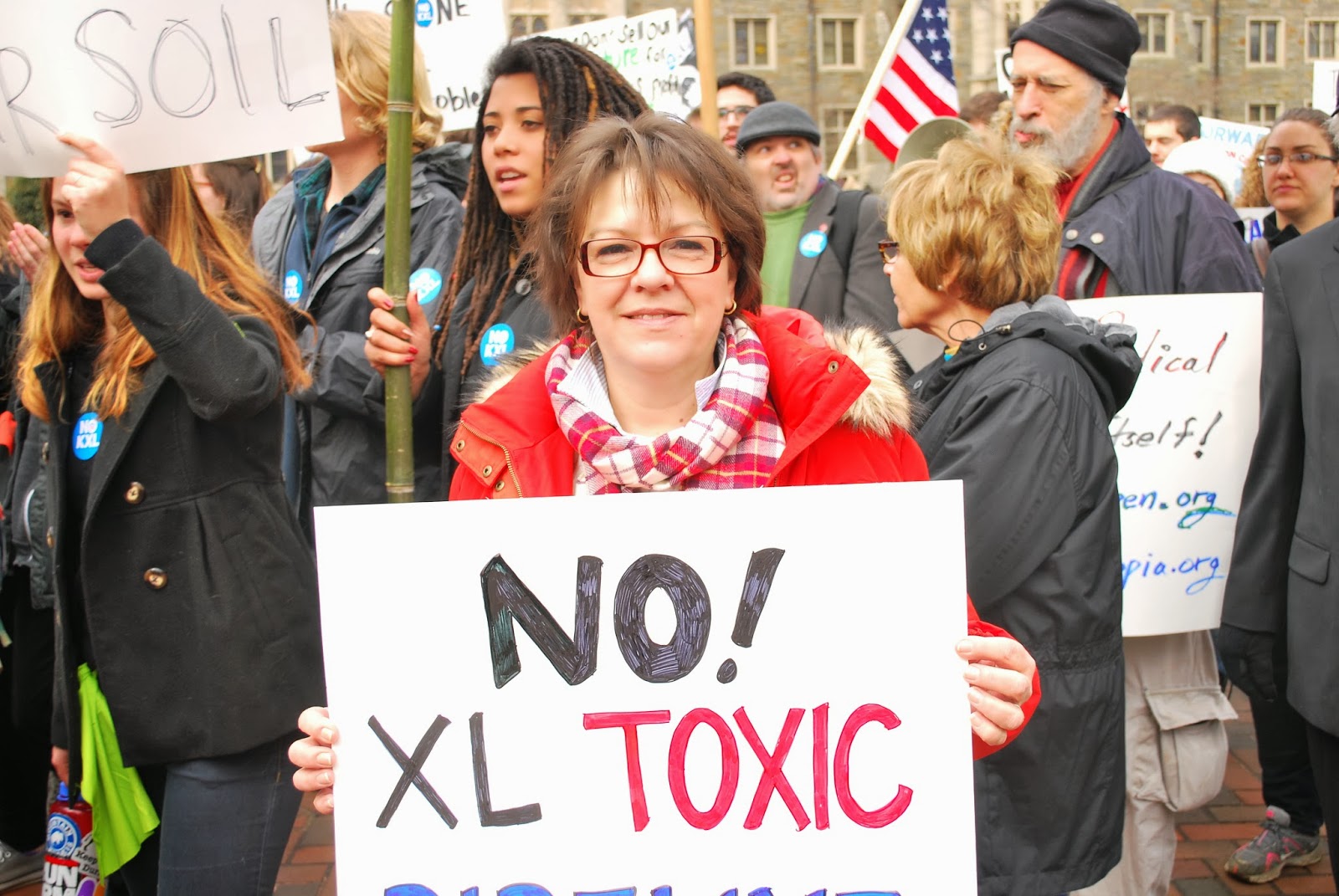
Four days after I moved to Washington, DC, on 28 August, 2014,I was fortunate enough to find my way into the 50th anniversary celebrations of the March on Washington. While the event was no protest, the goal was clear--direct political messaging, in this case about the confluences of racial and economic injustice. That day provided my first taste of attending more politically charged events in this city. Fast forward through a heated anti-drone summit by CODEPINK and a peace vigil in solidarity against the Keystone XL pipeline to today, when several hundred youth activists marched from the Red Square at Georgetown University to The White House to engage in civil disobedience dissent action to send a simple, concise, and extremely political message to President Barack Obama--say no to the construction of the northern leg of the Keystone XL pipeline.
Saying no to the pipeline sets the stage for a course correction on President Obama's "all of the above" energy policy, which is basically this: we can combat the social and ecological dimensions of climate change while still expanding offshore oil drilling, promoting fracking, continuing mountaintop removal, and becoming even bigger trade partners with Canada by importing their ecologically devastating oil. How such an energy policy can reduce America's dependence on fossil fuels and lighten this culture's burden on the world I do not know, but at the very least saying no to the pipeline is a serious symbolic commitment that activists can gather around to wean this country and the world of toxic and climate change-inducing fossil fuel energy.
Today, I am energized by the spirit of young climate change activists who came in buses and cars from all across the country and who zip-tied themselves to The White House fence and got arrested, with the intention of showing President Obama that the youth cares deeply about the causes and effects of climate change--physical, economic, social, political, ecological. I thus revive this blog from its hibernation by focusing my next several posts on the Keystone XL pipeline, both to educate myself and to provide you with information about the spectrum of issues that tar sands and the Keystone XL pipeline affects.
My next posts will focus on:
For now, I leave you with photos I took today during the dissent.




Saying no to the pipeline sets the stage for a course correction on President Obama's "all of the above" energy policy, which is basically this: we can combat the social and ecological dimensions of climate change while still expanding offshore oil drilling, promoting fracking, continuing mountaintop removal, and becoming even bigger trade partners with Canada by importing their ecologically devastating oil. How such an energy policy can reduce America's dependence on fossil fuels and lighten this culture's burden on the world I do not know, but at the very least saying no to the pipeline is a serious symbolic commitment that activists can gather around to wean this country and the world of toxic and climate change-inducing fossil fuel energy.
Today, I am energized by the spirit of young climate change activists who came in buses and cars from all across the country and who zip-tied themselves to The White House fence and got arrested, with the intention of showing President Obama that the youth cares deeply about the causes and effects of climate change--physical, economic, social, political, ecological. I thus revive this blog from its hibernation by focusing my next several posts on the Keystone XL pipeline, both to educate myself and to provide you with information about the spectrum of issues that tar sands and the Keystone XL pipeline affects.
My next posts will focus on:
- the science and engineering behind tar sands extraction, processing, and transport
- a brief foray into the social implications of tar sands
- the ecological impacts of tar sands, now and possible
- arrest, direct action, and the legal issues surrounding arrest for civil disobedience and dissent
- the climate change movement's relation to other social movements
- the State Department's environmental impact statement
For now, I leave you with photos I took today during the dissent.
Tuesday, June 18, 2013
With knowledge comes responsibility
What is the point of learning about the world if we live for ourselves?
What the is point of research and of generating knowledge if we do not
take what we learn to heart?
Scientists and engineers occupy a unique and powerful position in this culture, and they always have. While kooks and quacks no doubt exist, scientists and engineers do important work in chemistry, atmospheric sciences, biology, physics, ecology, building and designing. But if you're a scientist or engineer reading this, it is likely that you have been educated to (or at least told to) just doing the science and engineering, and leaving the decisionmaking that stems from it to others--policymakers, lawyers, businessmen, and politicians, many of whom do not have the best interests of people and nature at heart. Scientists and engineers thus leave it to others, others who many not fully understand the implications of this knowledge, to decide what should be done about what we know, so scientists and engineers do not lose their "objectivity," so they do not cross the supposedly strict boundaries between scientific, reductionist research and the murky world of "values."
But in this glacier-melting, toxic tresspassing, obesity-inducing, mass-species-extinction, large corporate culture, scientists and engineers can no longer sit on the sidelines of decisionmaking. Traditional means of scientific communication have led, for example, to politicians undermining and denying climate science (although in this episode of This American Life, it becomes clear that many politicians fully accept climate science, but just do not admit it). Instead, given the incredible diversity of thought, skill, and knowledge they possess, scientists and engineers must take full responsibility for what they know and do, and that is to become front and center the faces of the radical social, political and economic change needed to align this culture and its laws with ecological holism and peace.
Fortunately, there are a handful of such brave men and women out there already, and Sandra Steingraber heads the list of courageous scientist activists. A poet, essayist, author, environmentalist and ecologist, Steingraber has written extensively (in Orion magazine, among other places) about the links between industrial chemicals released into the environment and human health impacts, specifically cancer. Recently, she has been intimately involved with the opposition to the extremely destructive practice of fracking, for which she was jailed. In a conversation with Dick Gordon on The Story, Steingraber says,
Part 1 of Gordon's conversation with Steingraber.
Part 2 of Gordon's conversation with Steingraber.
Scientists and engineers occupy a unique and powerful position in this culture, and they always have. While kooks and quacks no doubt exist, scientists and engineers do important work in chemistry, atmospheric sciences, biology, physics, ecology, building and designing. But if you're a scientist or engineer reading this, it is likely that you have been educated to (or at least told to) just doing the science and engineering, and leaving the decisionmaking that stems from it to others--policymakers, lawyers, businessmen, and politicians, many of whom do not have the best interests of people and nature at heart. Scientists and engineers thus leave it to others, others who many not fully understand the implications of this knowledge, to decide what should be done about what we know, so scientists and engineers do not lose their "objectivity," so they do not cross the supposedly strict boundaries between scientific, reductionist research and the murky world of "values."
But in this glacier-melting, toxic tresspassing, obesity-inducing, mass-species-extinction, large corporate culture, scientists and engineers can no longer sit on the sidelines of decisionmaking. Traditional means of scientific communication have led, for example, to politicians undermining and denying climate science (although in this episode of This American Life, it becomes clear that many politicians fully accept climate science, but just do not admit it). Instead, given the incredible diversity of thought, skill, and knowledge they possess, scientists and engineers must take full responsibility for what they know and do, and that is to become front and center the faces of the radical social, political and economic change needed to align this culture and its laws with ecological holism and peace.
Fortunately, there are a handful of such brave men and women out there already, and Sandra Steingraber heads the list of courageous scientist activists. A poet, essayist, author, environmentalist and ecologist, Steingraber has written extensively (in Orion magazine, among other places) about the links between industrial chemicals released into the environment and human health impacts, specifically cancer. Recently, she has been intimately involved with the opposition to the extremely destructive practice of fracking, for which she was jailed. In a conversation with Dick Gordon on The Story, Steingraber says,
In the absence of a powerful human rights movement behind the science, I don't think we can move this forward. The world's most powerful industries are standing in our way. And so I think science needs to be coupled with a kind of activism, similar to what we saw with [the] Civil Rights [Movement], similar to what we saw with the Abolitionist Movement. And so, I feel inspired in the work that I do not just by the power of the data, whether it's on climate change, or on the growing evidence that we have linking childhood asthma to crummy air, [but also by how] Martin Luther King Jr. did what he did, and how my dad, at age eighteen, had to go off and fight global fascism even though at the time it looked like an overwhelming task...People under very desperate circumstances rose and said, "This is wrong."
I carry around this German name, Steingraber, and my dad [was] also German...and what I learned from my dad was to not be a "good German." If you see something is wrong because you have evidence, whether it is the kind of evidence that the French partisans had or whether it is evidence like I have as a biologist, we have a moral obligation to make sure that that evidence [leads to change]. You don't just say, "Here's the evidence," and that's your job, you're done. But if nobody is coming to take the evidence and turn it into change, then you have to do that yourself. It becomes your own responsibility.I hope to continue to develop these thoughts on the blog over the days and weeks to come; they formed an important part of my dissertation, and continue to be something I write about more academically. I hope to translate more of that writing here. I am sure many of you have thoughts on this very important issue, and I welcome them in the form of comments and even guest blog posts. Until then, I encourage you to listen to Gordon's full conversation with Steingraber, which I have posted below. You can also find the conversation on The Story's website, here.
Part 1 of Gordon's conversation with Steingraber.
Part 2 of Gordon's conversation with Steingraber.
Wednesday, June 5, 2013
Guest blog #29: Minimalist parenting by Crystal Thrall, part 2
I left off yesterday writing about elimination communication and breastfeeding and baby-led weaning. Today, I finish off writing a little bit about co-sleeping and babywearing.
Co-sleeping
I am going to take away all the fun of preparing for the arrival of a baby by suggesting that a nursery is simply not practical. The nursery: an entire room and furniture to fill it suited to the first year of a baby's life. Sure, that crib probably converts to a toddler bed, but I really think that even a crib is unnecessary. Why not skip the tiny mattress entirely and buy your child a proper mattress she can use throughout childhood? For that matter, why bother with a nursery at all? Why not make a fun room suited to your child's interests, when they become apparent, as she ages? Yes, I am implying that you share your bed with your child during the infant, and probably the toddler stage of her life. To make co-sleeping practical for us, we bought another mattress to increase our effective bed size, and we put our bed on the floor. I can hear you quietly thinking, "How do you ever have sex when you share a bed with your child?" That's a fair point to which I respond: it is possible to be intimate with your partner without having your bed available.
Babywearing
I was given many things by very well-intentioned friends and family that would help me put my baby down: an infant seat (a.k.a a Bumbo); colorful play mats with exciting toys that could stimulate many of my baby's senses; a swing and a bouncy seat--both of which played soothing music or simulated noises from the womb; and a stroller. I happily and gratefully accepted these gifts and hand-me-downs thinking it would be nice to put my baby down every now and then to have free hands. Little did I know not all babies willingly accept any distance from a warm body. Call them what you want: high-needs, fussy, colicky...I was/am the proud mother of one of these babies! It wasn't long before I realized each of these items was practically useless to me, and I thought I would never be able to put my baby down without having to listen to her scream. I knew that baby carriers existed, but the options overwhelmed me and I couldn't decide on one.
One glorious day, a friend of mine introduced me to a local babywearing group. I was honestly quite intimidated by the vast library of carriers and the babywearing proficiency demonstrated by these wonderful moms and dads...but mostly moms. Nevertheless, I knew this was the solution that would work for my husband and I. My carrier collection started with a simple ring sling crafted by my mother. I quickly learned how easy it was to just pop my daughter in and out of the sling and carry her hands free anytime, anywhere. Finally, I was liberated from my stroller! The burden of my baby gear load decreased significantly, and I would no longer be forced to awkwardly maneuver a stroller around any store. I didn't realize how much I loathed the stroller concept until I acquired my ring sling. You can see a picture of me and a passed out organic baby in yesterday's post. Here is one of my husband, Brian, with baby Rae awake.
Now that I could leave the house with a happy baby, my next babywearing goal was to free my hands for domestic duties. I had to learn how to wear my daughter on my back, and for this I would need a wrap which is essentially just a very long piece of fabric. Even more overwhelming than choosing a specific type of carrier was selecting a wrap! There are various sizes, colors, fabric blends, and brands, and in the end I learned many people choose their first wrap based on the color. After buying a wrap and learning how to back-carry, I could resume many of my pre-baby activities while providing entertainment for my baby. My daughter especially enjoyed watching me sweep the floors as I wore her on my back. She still does, but she would prefer to sweep the floors herself (especially after she's involved in a mishap...not really, but maybe some day!).
That leads me to the semi-babywearing-related topic of toys. In the first year, a child needs few, if any, toys. At this age, babies can be entertained by things you already have in your home, or better yet, outside. What's even more entertaining than things is mom and dad and the activities they do.
Final thoughts
I must confess that I have simply summarized the concept of "attachment parenting" from a different perspective. Attachment parenting is what works for our family. Coincidentally, this parenting style achieves another goal of ours--minimizing our impact on the environment.
While putting together this post, my husband said that I should discuss his perspective throughout this process. Here goes: Initially, he was opposed to co-sleeping, babywearing, and elimination communication. He reluctantly followed my lead, but became more accepting as we progressed into a routine. When he observed how happily our daughter would eliminate on a potty, he was no longer an EC skeptic. He also appreciates doing less laundry and going out with less baggage. When he started wearing our daughter, he appreciated the increased closeness and interaction he didn't get with the stroller. And he quickly learned that co-sleeping gave him the ability to sleep more during the night. Eventually, his entire view on what parenting should look like changed, and he will not do it any other way now. (Now, on to conquering the world!)
Attachment parenting is probably not the only environmentally friendly parenting style, but this is what works for us. Ultimately, you have to do what is best for you and your family. I am quite satisfied with how relatively little clutter there is in my postpartum home and how my daughter doesn't require much baggage when we go out. If minimizing the baby gear in your life is your goal, then you might want to consider wearing, breastfeeding, pottying, and/or sleeping with your baby!
Resources
There's a ton of used baby things out there! And always remember, craigslist is your friend!
Elimination communication
The Diaper-Free Baby: The Natural Toilet Training Alternative by Christine Gross-Loh
EC Simplified: Infant Potty Training Made Easy by Andrea Olson
Andrea Olson's EC website: godiaperfree.com
kellymom.com
Breastfeeding and Baby-led Weaning
Lactation consultant directory
The Womanly Art of Breastfeeding by Diane Wiessinger, Diana West, and Teresa Pitman
So That's What They're For!: The Definitive Breastfeeding Guide by Janet Tamaro
Baby-led Weaning: Helping Your Baby To Love Good Food by Gill Rapley
kellymom.com
Babywearing
Find a babywearing chapter near you here
Babywearing blog from my local Babywearing chapter
There are also plenty of instructional youtube videos available!
Co-sleeping
I am going to take away all the fun of preparing for the arrival of a baby by suggesting that a nursery is simply not practical. The nursery: an entire room and furniture to fill it suited to the first year of a baby's life. Sure, that crib probably converts to a toddler bed, but I really think that even a crib is unnecessary. Why not skip the tiny mattress entirely and buy your child a proper mattress she can use throughout childhood? For that matter, why bother with a nursery at all? Why not make a fun room suited to your child's interests, when they become apparent, as she ages? Yes, I am implying that you share your bed with your child during the infant, and probably the toddler stage of her life. To make co-sleeping practical for us, we bought another mattress to increase our effective bed size, and we put our bed on the floor. I can hear you quietly thinking, "How do you ever have sex when you share a bed with your child?" That's a fair point to which I respond: it is possible to be intimate with your partner without having your bed available.
Babywearing
I was given many things by very well-intentioned friends and family that would help me put my baby down: an infant seat (a.k.a a Bumbo); colorful play mats with exciting toys that could stimulate many of my baby's senses; a swing and a bouncy seat--both of which played soothing music or simulated noises from the womb; and a stroller. I happily and gratefully accepted these gifts and hand-me-downs thinking it would be nice to put my baby down every now and then to have free hands. Little did I know not all babies willingly accept any distance from a warm body. Call them what you want: high-needs, fussy, colicky...I was/am the proud mother of one of these babies! It wasn't long before I realized each of these items was practically useless to me, and I thought I would never be able to put my baby down without having to listen to her scream. I knew that baby carriers existed, but the options overwhelmed me and I couldn't decide on one.
One glorious day, a friend of mine introduced me to a local babywearing group. I was honestly quite intimidated by the vast library of carriers and the babywearing proficiency demonstrated by these wonderful moms and dads...but mostly moms. Nevertheless, I knew this was the solution that would work for my husband and I. My carrier collection started with a simple ring sling crafted by my mother. I quickly learned how easy it was to just pop my daughter in and out of the sling and carry her hands free anytime, anywhere. Finally, I was liberated from my stroller! The burden of my baby gear load decreased significantly, and I would no longer be forced to awkwardly maneuver a stroller around any store. I didn't realize how much I loathed the stroller concept until I acquired my ring sling. You can see a picture of me and a passed out organic baby in yesterday's post. Here is one of my husband, Brian, with baby Rae awake.
 |
| Brian, organic baby, and a ring sling on Main Street in Ann Arbor |
That leads me to the semi-babywearing-related topic of toys. In the first year, a child needs few, if any, toys. At this age, babies can be entertained by things you already have in your home, or better yet, outside. What's even more entertaining than things is mom and dad and the activities they do.
Final thoughts
I must confess that I have simply summarized the concept of "attachment parenting" from a different perspective. Attachment parenting is what works for our family. Coincidentally, this parenting style achieves another goal of ours--minimizing our impact on the environment.
While putting together this post, my husband said that I should discuss his perspective throughout this process. Here goes: Initially, he was opposed to co-sleeping, babywearing, and elimination communication. He reluctantly followed my lead, but became more accepting as we progressed into a routine. When he observed how happily our daughter would eliminate on a potty, he was no longer an EC skeptic. He also appreciates doing less laundry and going out with less baggage. When he started wearing our daughter, he appreciated the increased closeness and interaction he didn't get with the stroller. And he quickly learned that co-sleeping gave him the ability to sleep more during the night. Eventually, his entire view on what parenting should look like changed, and he will not do it any other way now. (Now, on to conquering the world!)
Attachment parenting is probably not the only environmentally friendly parenting style, but this is what works for us. Ultimately, you have to do what is best for you and your family. I am quite satisfied with how relatively little clutter there is in my postpartum home and how my daughter doesn't require much baggage when we go out. If minimizing the baby gear in your life is your goal, then you might want to consider wearing, breastfeeding, pottying, and/or sleeping with your baby!
Resources
There's a ton of used baby things out there! And always remember, craigslist is your friend!
Elimination communication
The Diaper-Free Baby: The Natural Toilet Training Alternative by Christine Gross-Loh
EC Simplified: Infant Potty Training Made Easy by Andrea Olson
Andrea Olson's EC website: godiaperfree.com
kellymom.com
Breastfeeding and Baby-led Weaning
Lactation consultant directory
The Womanly Art of Breastfeeding by Diane Wiessinger, Diana West, and Teresa Pitman
So That's What They're For!: The Definitive Breastfeeding Guide by Janet Tamaro
Baby-led Weaning: Helping Your Baby To Love Good Food by Gill Rapley
kellymom.com
Babywearing
Find a babywearing chapter near you here
Babywearing blog from my local Babywearing chapter
There are also plenty of instructional youtube videos available!
Tuesday, June 4, 2013
Guest blog #29: Minimalist parenting by Crystal Thrall, part 1
Crystal Thrall, queen of the Diva Cup, is back, and this time, she writes about her new baby girl, and her efforts to minimize the ecological impacts of infancy.
My
parenting journey began unconventionally by planning a home birth, but I
followed the mainstream idea of what babies need: diapers, a crib, a stroller,
a car seat, and so forth. As someone who
lives a relatively minimalist life, I was troubled by the thought of adding all of
this child-related baggage to my clutter-free home. Over time, I realized that most baby gear is wasteful,
unnecessary clutter, especially in the first year. I know, you probably think I am nuts. "How can you live without a stroller?" "There is no way I am going to carry my baby
everywhere!" "And diapers? Come on, babies certainly need those!" "What about entertainment? My baby will get bored!" I admit that these ideas did not come
naturally to me; however, I learned from other parents with similar
interests. All parenting philosophies
aside, if your main goal is to minimize your environmental impact, the
following topics might interest you: elimination communication; breastfeeding
and baby-lead weaning; co-sleeping; and babywearing. Today, I write about the first two.
Elimination
Communication
The
guiding principle behind elimination
communication (EC) (also known as natural
infant hygiene, infant potty training, or gentle potty training) is that people are born with the instinct
to not soil themselves. Babies
communicate the need to eliminate just as they communicate other basic needs,
and as parents it is our job to understand when that need should be met. By exclusively diapering a child, the child learns
that caregivers will not meet this particular need and that the appropriate
place to eliminate is in his pants.
Imagine how confusing it must be after two or three years of eliminating
in your pants to learn that you are actually supposed to use a toilet! I won't go into the details about how to
establish this sort of relationship with your baby, there are plenty of
references out there that do a much better job than I ever could. But I will share my personal
experience.
While
I was pregnant, I thought I was doing my environmental due diligence by
committing to cloth diapers. Knowing
that I would save landfills from a large volume of solid waste while protecting
my baby's bottom from diaper rash made the additional laundry burden worth it. For five months, we happily cloth-diapered
our child until a friend and fellow new parent introduced us to the concept of elimination communication. From the day her son was born, she
started putting him on the potty. I
admit that I was skeptical at first, but after reading Diaper Free Baby, I knew that I had to at least try introducing my
infant to the potty. It wasn't long
before my daughter refused to poop in her pants, and what an exciting accomplishment
that was for us. At this point, I was
completely sold. Now our daughter is 16
months old, and while she still has accidents, she doesn't wear diapers during
the day and spends most of her time dry.
She directly communicates her elimination needs with either a hand signal
or words. Our experience has completely
changed my perspective and opinion on diapers, and we are fully committed to
respond to any future child's elimination needs in this way from birth.
Some
people would say that "elimination
communication" sounds wonderful, but isn't practical for a child with two
working parents. The beauty of EC is that it can be accomplished part time and with
zero stress. Anything that ends up in a
potty results in fewer diaper changes, and therefore less waste, so why not try
it?!
Breastfeeding
and Baby-led Weaning
Breastfeeding
is a sensitive and controversial topic for many women. Personally, I never questioned whether or not
I wanted to breastfeed. And while my
breastfeeding relationship was easily established with my baby, I have met
numerous women who have struggled for weeks, even months to exclusively
breastfeed their babies. I have also
known women who, despite their best efforts, were unable to maintain breastfeeding
for physical or psychological reasons beyond their control. Breastfeeding is certainly not something
women can take for granted, but even if it takes blood, sweat, tears, and a lot
of time, the benefits to both mom and baby are well worth it.
Well
that's great, but my main point is to minimize "stuff consumption." Obviously, if a baby receives his meals
exclusively from mom, infant formula and the waste associated with it is
completely unnecessary. If mom stays at home,
the need to bottle-feed is also unnecessary.
However, many moms work in which case bottles and breast pump supplies
are probably necessary. In the end
breastfeeding can still lead to waste, but less so than formula-feeding.
Breastfeeding
is probably the obvious environmentally-friendly choice to many people, but
what about the weaning process? When I
was pregnant, I had every intention making my own pureed baby food. It could be organic, I could make my own
concoctions suited to my baby's tastes, I would save money, AND I would
contribute less waste by not buying packaged baby food! This sounded like a great plan until I learned
about baby-led weaning (BLW) which makes it even easier to avoid packaged baby
food. It's quite simple: let your child
feed himself. This means that the child
eats finger foods rather than purees.
For us this means our child generally eats what we prepare for ourselves. Honestly, BLW probably lengthens the path to
weaning, so you have to be willing to commit to an extended breastfeeding
relationship with your child. As a mom
who has been breastfeeding for 16 months, I know that it isn't always
easy. However, I didn't go into
parenting thinking it would be easy, and I know she won't be breastfeeding
forever.
Come back tomorrow to read part 2 of Crystal's guest blog!
 |
| Crystal, a nuclear engineer, and her organic baby. |
 |
| Brian, Crystal's husband, also a nuclear engineer, with his organic baby. |
Wednesday, May 29, 2013
"Sustainability is illegal."
I find law fascinating, and I would love to write about it more. But for this blog post, I would rather you spend your time listening to Thomas Linzey, Esq., co-founder and executive director of the Community Environmental Defense Legal Fund, which intends and works on "Building sustainable communities by assisting people to assert their right to local self-government and the rights of nature." In the audio clip below taken from the fantastic radio show Making Contact, Linzey talks about ways to morph the current regulatory and property rights framework of environmental law to one that affords nature rights and better protects the rights of citizens in the face of ever-growing corporatization and pollution. As it stands however, according to Linzey, "Sustainability is illegal. The hammer comes down on you when you attempt to actually to prohibit something in the interest of building sustainability in [a] community."
Tuesday, May 28, 2013
Guest blog #28: Scott Wagnon's thoughts on population
(My last post generated a lot of activity on Facebook. I also received an email from my labmate Scott Wagnon, whose detailed response to the post is below as a guest blog post.)
I feel as if Darshan downplayed the role population plays on environmental issues. Where I wholeheartedly disagree with the unnamed professor (and I know Darshan does, too) is that race is a factor in the interconnection between the environment and population. Environmental impact is something that is caused and felt by all age, race, gender and socioeconomic demographics. I know and recognize that certain slices of the demographic pie contribute and/or are impacted more significantly than other slices, as Darshan mentioned in his post.
From any perspective, it is just and right to advocate on behalf of people whose rights have been impacted, whose voice cannot reach a broad audience, or whose voice may not have the same impact as ourselves as wealthy, "educated" people. But the simple fact remains that we--all of humanity--cannot have tens of billions of people consuming a few resources, as much as we--all of humanity-- cannot have a few people consuming tens of billions of resources. Population control via family planning through various birth control options, abstinence, and education (see Darshan's post on the "entitlement" of having children, and the short discussion generated); increases in efficiency; and reduced consumption of resources are three equally important ways to reduce the impact of the choices we make.
Those of us, such as Darshan and myself and likely you, who have been empowered with the means to make and enact such choices, should especially look at every aspect. As Darshan pointed out in his post, wealthy, "educated" people--us--often consume the most. (On a side note, I use "educated" because I wonder how smart we really are based on certain decisions that we make as a society... having to look no further than our collective treatment of the environment.) If we--the large consumers, including myself :/--choose not to have large families, use less resources, and use resources more efficiently, we're fostering a culture where the environment is valued not as a commodity, but as something for all of humanity to enjoy. We live in a finite world, so barring our expansion beyond this beautiful planet, all of humanity must always remain mindful that Earth can only sustain a finite population at even the smallest necessary levels of resource consumption. We are all effectively one family altering our common home, for better or worse, through the choices we make. I hope we all continue to make better choices.
~Scott Wagnon
Friday, May 24, 2013
Thoughts on the population issue
I just returned from a trip to the US National Combustion meeting in Utah, which was perhaps my last hurrah in combustion for the foreseeable future. Here is the beginning of a conversation I had with a professor who shall not be named at the Sunday evening reception:
Enough about climate change broadly. Let's get into the specifics of population. I will not deny that the world and many nations face massive challenges of population. But blaming population growth occurring today for past ecological degradation that has caused injustice today is to deny culpability, to shrug off any responsibility for our actions. There is no way to buy most electronics or textiles or food that has been manufactured or produced without degrading impacts. Our electricity comes from coal and fossil fuels, which require mountaintop removal and tailing ponds and people to cut down forests. By buying what we do, by using energy and electricity the way we do, we link ourselves to socioecological injustices of pollution and degradation elsewhere. Environmental injustice is about people being socioeconomically or politically forced into living in degraded places, most times to serve the wants of the rich and powerful. It is built into and a necessity of our economic and policy structures. The population growth occurring all over the world only serves to expose these injustices.
As you expect (and while I am sure he had to work hard to be where he is), the unnamed professor is not a poor person. He is a rich and now privileged person living in an industrialized country. I am, too. All in all, the per capita emissions of greenhouse gases in industrialized countries, the demands of heavy metals and plastics and chemicals, are still several times higher than those in industrializing countries. Therefore, individual action to reduce ecological impacts on the part of people living in industrialized countries is the equivalent of several people in industrializing countries doing so. Population is part of the issue, but individuals are, too.
My advisor: This is my student, Darshan. He just graduated a little while ago.
Unnamed professor: What are you doing now?
Darshan: Traveling, and then headed to the US Environmental Protection Agency in August.
Unnamed Professor: What are you going to do there?
Darshan: I will be working on issues of environmental justice and sustainability both within and outside of the EPA.
Unnamed Professor: To be blunt, the issue about environmental justice is just about a bunch of black people having too many children and choosing to live in polluted places.Perhaps one of the most insightful thoughts I have heard about the population issue in a long time comes from a 2008 conversation that Jeff Goodell had with James Gustave Speth, published in Orion Magazine and Change Everything Now.
Goodell: ...And you can say--as you do--that we consume too much, and that our economic system has become a slave to the idea of an ever-expanding GDP. But you could also just say, "Look, there are too many people on the planet--"
Speth: Well, I think a lot of people believe that. I actually have a law, Speth's Law, and it is that the richer you are, the more you think that population is the world's problem. But the scale of the impact is really derived from the phenomenal amount of economic growth in rich countries, not from the phenomenal population growth.Several facts bolster Speth's claim. In case of climate change, for example, the majority (~60%) of historical emissions of greenhouse gases has occurred in just the handful of industrialized countries in the US, Russia, Germany, UK, Japan, France, and Canada. Sticking with climate change (an issue laden with environmental justice issues), much of the greenhouse gas emissions in industrializing nations such as China are caused due to emission from the production of objects for industrialized countries. Even though the populations of China and India are increasing, the slowly increasing population of the US and the decreasing populations of Western Europe still have much greater ecological impacts. (I suggest taking a look at this [and this!] incredibly cool interactive graphical tool to visualize how the poorest are most vulnerable to the impacts of climate change, and how blaming population increases in industrializing countries is misleading.)
Enough about climate change broadly. Let's get into the specifics of population. I will not deny that the world and many nations face massive challenges of population. But blaming population growth occurring today for past ecological degradation that has caused injustice today is to deny culpability, to shrug off any responsibility for our actions. There is no way to buy most electronics or textiles or food that has been manufactured or produced without degrading impacts. Our electricity comes from coal and fossil fuels, which require mountaintop removal and tailing ponds and people to cut down forests. By buying what we do, by using energy and electricity the way we do, we link ourselves to socioecological injustices of pollution and degradation elsewhere. Environmental injustice is about people being socioeconomically or politically forced into living in degraded places, most times to serve the wants of the rich and powerful. It is built into and a necessity of our economic and policy structures. The population growth occurring all over the world only serves to expose these injustices.
As you expect (and while I am sure he had to work hard to be where he is), the unnamed professor is not a poor person. He is a rich and now privileged person living in an industrialized country. I am, too. All in all, the per capita emissions of greenhouse gases in industrialized countries, the demands of heavy metals and plastics and chemicals, are still several times higher than those in industrializing countries. Therefore, individual action to reduce ecological impacts on the part of people living in industrialized countries is the equivalent of several people in industrializing countries doing so. Population is part of the issue, but individuals are, too.
Monday, May 13, 2013
The jagged edges of the Keeling Curve
This time it made the headlines. Something as vague and intangible as an invisible, odorless gas is encapsulated in a concrete number. 400 parts per million, a level of carbon dioxide not seen for the past three to five million years.
The number is in fact not intangible. It is very real, real because sea levels are rising millimeter by millimeter, submerging island nations such as the Maldives and heavily populated coastlines. The number is real because the summer of 2012 was the hottest summer on record in the United States. The number is real because of the acidification of oceans and coral bleaching; because of drier forests fueling larger fires; because of the ever-shrinking amount of polar ice; because entire villages in Alaska are needing to be moved because of thawing land, to the tune of $380,000 per person.
In spite of all of this very real evidence of the effects of climate change, nothing new is being said that can wash away the line that have been drawn in the sand that divides the "believers" from the "skeptics". (If you don't "believe" in climate science, perhaps you might question your beliefs in most any science that you rely on in your daily life.) Perhaps it is time for a new story about climate change, a new story that connects old facts. Perhaps our sole focus on the emission of greenhouse gases as a technological deficiency is distracting us from the real issues; framing climate change as a “carbon” problem is “possibly the greatest and most dangerous reductionism of all time: a 150 year history of complex geologic, political, economic, and military security issues all reduced to one element.” [1]
As a postdoctoral researcher, I wonder if Charles Keeling thought about the symbolism of his scientific endeavors in the thin air of Mauna Loa Observatory in Hawai'i. The jagged edges of the Keeling Curve are symbolic of the sharp divides and fractures in our politics, and under our feet in the fracked Marcellus Shale. The jagged edges show how cruelly we continue to cut and lacerate this earth, just as is being done in the forests of Canada to access tar sands. The curve is symbolic because not only does it show that carbon dioxide levels are rising, but that also our hubris is, too--the hubris of thinking that we may be able to engineer ourselves out of this problem.
As a postdoctoral researcher, I wonder if Charles Keeling thought about the symbolism of his scientific endeavors in the thin air of Mauna Loa Observatory in Hawai'i. The jagged edges of the Keeling Curve are symbolic of the sharp divides and fractures in our politics, and under our feet in the fracked Marcellus Shale. The jagged edges show how cruelly we continue to cut and lacerate this earth, just as is being done in the forests of Canada to access tar sands. The curve is symbolic because not only does it show that carbon dioxide levels are rising, but that also our hubris is, too--the hubris of thinking that we may be able to engineer ourselves out of this problem.
 |
| From The Scripps Institution of Oceanography |
[1] Thomas Princen, “Leave It in the Ground: The Politics and Ethics of Fossil Fuels and Global Disruption” prepared for the International Studies Association International Conference, Montréal, March 16-19, 2011; to appear in State of the World 2013.
Friday, April 26, 2013
Let it go
Barry Schwartz, in his book Paradox of Choice, talks about the confluence of freedom and choice. He says (and you can see this in his TED talk, which I have added below) that one of the central ideologies of Western industrial society is that freedom is inherently good (well, it depends on what kind, right?), and that today this freedom is manifest in expanding choice for individuals. Our supermarkets host hundreds of kinds of cookies and salad dressings (even though crop diversity has been on the decline), and electronics stores have every single combination of processor speed and physical memory and screen type you can hope for. Yet, as Schwartz claims, increased choice doesn't lead to satisfaction or happiness. Rather, we are crippled with regret or anticipated regret that we could have made another or better choice because we expect too much from our choices, and in the end we blame ourselves for our lack of satisfaction.
To be more specific, though, Schwartz's talk is broadly about how material choice relates to our happiness or satisfaction, and to extend Schwartz's thoughts, regret and anticipated regret and self-blame can make us continually buy things with the expectation and hope that we will feel better about ourselves. This ties us into the bind of continually buying material products that are decidedly not socioecologically benign; the new phones we buy are still made of heavy metals and rubber and plastic by people who are treated poorly.
This is not to say that we should live non-material lives; cutting ourselves completely from this culture will do very little to change it. We live in a material world and I hope that all of us want to do something about its socioecological destructiveness. Finding that balance, that is, being able to participate in this culture while advocating for and acting toward change requires participation and engagement, not isolation.
Making a choice and being satisfied and/or happy with it requires letting go of the perceived benefits or costs of your choice. Letting go is about making choices and not being affected by comparisons of what we have to what others do, and not being affected by imagining our lives had we made another choice. Rather, we must stand by the choices we make to free our minds towards the positive, the constructive, rather than remorse, regret, and self-blame. Letting it go opens up space to recentre and redouble our efforts on what must be done about social injustice and ecological degradation rather than tethering ourselves to choices that cause injustice and degradation. A phone is a phone, and if my phone can't look up Wikipedia, big deal.
To be more specific, though, Schwartz's talk is broadly about how material choice relates to our happiness or satisfaction, and to extend Schwartz's thoughts, regret and anticipated regret and self-blame can make us continually buy things with the expectation and hope that we will feel better about ourselves. This ties us into the bind of continually buying material products that are decidedly not socioecologically benign; the new phones we buy are still made of heavy metals and rubber and plastic by people who are treated poorly.
This is not to say that we should live non-material lives; cutting ourselves completely from this culture will do very little to change it. We live in a material world and I hope that all of us want to do something about its socioecological destructiveness. Finding that balance, that is, being able to participate in this culture while advocating for and acting toward change requires participation and engagement, not isolation.
Making a choice and being satisfied and/or happy with it requires letting go of the perceived benefits or costs of your choice. Letting go is about making choices and not being affected by comparisons of what we have to what others do, and not being affected by imagining our lives had we made another choice. Rather, we must stand by the choices we make to free our minds towards the positive, the constructive, rather than remorse, regret, and self-blame. Letting it go opens up space to recentre and redouble our efforts on what must be done about social injustice and ecological degradation rather than tethering ourselves to choices that cause injustice and degradation. A phone is a phone, and if my phone can't look up Wikipedia, big deal.
Monday, April 22, 2013
The Overview Effect
Our capacity to switch back and forth between scales of time and place--to understand the global, to acutely observe the local; to learn from the past and act compassionately for the future--is what seems to be in short supply with coming to terms with burgeoning and intricate problems such as climate change and sustainability. We constantly narrow our focus when the problems at hand are large, and we blame structures when it comes to changing what goes on in our households. And so, on this Earth Day, I wanted to share a video with you (which I found posted on my friend's Facebook page a few weeks ago) that helps us make connections of scale, that helps inspire wonder in our minds and activism from the heart. On this Earth day, Overview inspires the aerospace engineer in me, and, more importantly, provides all of us with boundless meaning to the word and the notion of our home, Earth.
Saturday, April 6, 2013
Traveling at home: Annie Clark and her cafe
Since it has been so long since I have written a traveling
at home piece, here are some older thoughts on why I do it.
I feel like the notion of traveling at home falls squarely in line with attempts at reducing trash. When we appreciate what we have, and where we are, we may start looking for beauty, pleasure and wonderment here and now. We don't have to pine to travel to some far out corner of the world, although that would be nice sometimes. We don't have to pine for something from somewhere else, although that would be nice, too. This may seem like some sort of "localism," and maybe it is, but I think it is more. I have not read much about localism but what I hope it means is more than just a patronising of businesses and groups that are close to you. I hope it means that there is a satisfaction with place with a full understanding of what needs to be done environmentally, and consequently socially, to lessen our burden on this planet...I would like to find out what it is that people appreciate about the places they are in, and when and why they decide to call it home
Café Mooset recently reopened in Bloomsburg right next to
Art Space, and right across from the Bloomsburg Theatre Ensemble. I have been going there religiously when in
Bloomsburg, for the quietness of the space, the art on the walls, and the
company of Annie Clark, owner and chef. My
interview was cut short by customers, and so it didn’t come to its tonic, but
here is a part of her life and her thoughts on home.
 |
| Cafe Mooset |
 |
| Art always |
 |
| Annie |
I live about three miles east of Sunbury on Sawmill road, on
the side of a mountain overlooking a beautiful east-west valley. I live on the dark side of the mountain. But, I grew up in the northern part of
Pennsylvania, close to the New York border, in Silver Lake. Silver Lake is nine miles north of Montrose,
and I still call Silver Lake home. We
used to move twice a year from our home in Silver Lake, though, because it
wasn’t weatherized for winter. So, we
moved twice a year. In that way, home
had to be wherever I was, just like for a military family. Fortunately, we moved in the same area, and
so I maintained relations with the same kids in the same school.
How has home changed over time?
It has been developed.
It was once rural, and actually remote, given its proximity to a city
and a town. I just drove there the other
day, and where there were once trees are now houses dotted all around. There used to be a lot of farmland, too, but
the houses used to be clustered in small areas.
The other kids in school used to live five or ten miles away, and so when
I wanted to see them, we had to plan the visits. Nothing was walking distance. The cottages in my area were populated in the
summer, and then no one would be around.
I loved it.
What did you at home?
Well, my brother was a boy.
I was closest to the sons from the next farm, and we would always go to
the water together. I used to do a lot
of stuff on their farm, and as I got older, a horse got involved. My father was not a farmer, but a French
teacher. After teaching, he spent the
rest of his life in Binghamton, working on flight simulators.
How has the environment at home changed over time?
During the late fifties and early sixties, there was a
drought in the area. You couldn’t make
it farming, and so everyone got other jobs, or they would try to farm during
the day, and then have a 3-11 pm night shift job. The farmers of the smaller farms that were
less productive started selling parcels of their land to give way for more
houses. I still remember the dwindling
size of the grass and hay bales. Then
again, everything goes back to the way it was when you stop doing what you
do.
There was a rule about the number of cottages that could be
along the lake, and there was never supposed to be two rows of them along the
lake. Because it was a mountain lake,
all the runoff ended up in the lake, and it began to suffer from
pollution. They fixed it all though, but
I am not sure how.
Subscribe to:
Posts (Atom)