This post is a continuation of a previous post, which was about the kinds of food poor people have access to, and choose to eat, in different parts of the world. My observations, which are not novel at all, are that the poor in less industrialised countries (such as India and Bangladesh), while eating fewer calories, eat hardier foods like lentils, grains and rice; the poor here are no where close to being overweight or obese. Rather, the poor are thin, wiry and muscular, particularly if they are involved in manual labour. This is in contrast to what the poor in industrialised nations such as the US eat - fast food, junk food and soda. The poor in the US are thus obese and overweight. Michael Pollan, in his piece for The New York Times a few years ago, wrote,
"A few years ago, an obesity researcher at the University of Washington named Adam Drewnowski ventured into the supermarket to solve a mystery. He wanted to figure out why it is that the most reliable predictor of obesity in America today is a person’s wealth. For most of history, after all, the poor have typically suffered from a shortage of calories, not a surfeit. So how is it that today the people with the least amount of money to spend on food are the ones most likely to be overweight?
Drewnowski gave himself a hypothetical dollar to spend, using it to purchase as many calories as he possibly could. He discovered that he could buy the most calories per dollar in the middle aisles of the supermarket, among the towering canyons of processed food and soft drink. (In the typical American supermarket, the fresh foods — dairy, meat, fish and produce — line the perimeter walls, while the imperishable packaged goods dominate the center.) Drewnowski found that a dollar could buy 1,200 calories of cookies or potato chips but only 250 calories of carrots. Looking for something to wash down those chips, he discovered that his dollar bought 875 calories of soda but only 170 calories of orange juice.
As a rule, processed foods are more “energy dense” than fresh foods: they contain less water and fiber but more added fat and sugar, which makes them both less filling and more fattening. These particular calories also happen to be the least healthful ones in the marketplace, which is why we call the foods that contain them “junk.” Drewnowski concluded that the rules of the food game in America are organized in such a way that if you are eating on a budget, the most rational economic strategy is to eat badly — and get fat."
However, my friend Sara, who has been living in Bangladesh for the past few years and working on media, health, and poverty issues, observed, "I have started to see a change however, even in just the past few years in Bangladesh, these high in salt foods, soft drinks, chips etc. are becoming more available especially to those living on $2 a day here. I imagine that we will see a shift, and even a double burden of disease to come not only communicable diseases that you mentioned, along with malnutrition, but also obesity, heart disease and long term health risks in Bangladesh and other eastern societies."
I personally have noticed in India that over time, McDonald's food has become cheaper compared to healthier food options, particularly in places where McDonald's is located, i.e., cities like Mumbai and Delhi. Mumbai, as you might know, is one of the priciest cities in the world. Yet when McDonald's first arrived in India in the early 2000's, prices (of say, a burger there) were definitely much higher than the average price of a sandwich off of the street. But as prices of vegetables and grains have gone up over time, street food has become more expensive, while I've noticed that prices at McDonald's have actually gone down. What worries me, particularly looking at presentations like the one here, is the aggression with which companies like McDonald's want to move into India. And with the little neo-classical economics that I know, I am sure they are out to outcompete, undersell and be the cheapest food option available in places like India and Bangladesh as time goes one. What hasn't changed over time, though, is the healthfulness of such food options.
How this might play out over time I'll leave up to you.
Showing posts with label New York Times. Show all posts
Showing posts with label New York Times. Show all posts
Friday, June 3, 2011


Sunday, April 17, 2011
FRACK YOU - A series on the rape of the Earth and its people
"I have come to believe that extracting natural gas from shale using the newish technique called hydrofracking is the environmental issue of our time. And I think you should, too." ~Sandra Steingraber in Orion
I didn't expect to be writing about the toxic process of hydrofracking, which I have read about over the past months, until I read this horrific article by Ian Urbina, "Millions of Gallons of Hazardous Chemicals Injected Into Wells, Report Says" in the NYTimes today. The article was written as a part of their Drilling Down series.
I do not want to go into the details of how hydrofracking is conducted right now, apart from saying that toxic chemicals, and a lot of them, are pumped into the ground at high pressure to crack rock formations underground, releasing natural gas. (You can read more about the entire process through a fantastic multimedia graphic here.) In the end, we end up with wastewater at the surface that contains obscene amounts of radioactive materials, carcinogens and corrosive salts. (You can look at a detailed interactive graphic of contaminated sites in Pennsylvania here) Sometimes, this wastewater is sent to normal treatment plants that do not have the capacity to treat for this toxins and radioactives; nonetheless the water is released into rivers. At the same time, there is contamination of groundwater and aquifers and wells with these chemicals. There has been so much talk about hydrofracking recently, and recent episodes of the The Story (here, here, here) have discussed the issue in various parts of the country, from various perspectives. You can also find documents about the politics of this process here.
Over the next few days and weeks, I will be writing about hydrofracking, in a series I am titling FRACK YOU. I will be tying together various threads of thought that have emerged in this blog over the past months, including rape of the Earth, risk, vulnerability, government regulation, corporate competition, care, respect, proxies and anecdote.
 |
| "A sign warns against swimming in a holding lake in Texas, where Fountain Quail Water Management separates and cleans hydrofracking water." From nytimes.com. |
Saturday, January 22, 2011
On my declining faith in government
I was at the EPA National Vehicle Emissions Testing Facility the other day when it was announced that there would be a new "public-private" partnership between the EPA and Chrysler to develop hydraulic hybrid technology for light duty vehicles such as minivans. The EPA Administrator, Lisa Jackson, was there along with Chrysler Chairman Sergio Marchionne introducing a "new model relationship" between the government and corporations - one in which the government and industry will work hand-in-hand. I was particularly surprised at how many times Jackson called residents of the US "consumers." The newly elected Lieutenant Governor, Brian Calley, was there as well, speaking about how his "family of five consumers" would benefit greatly with this new product. I got the feeling, along with my friends who agreed, that the tone of the government, represented through Jackson and the EPA, was markedly subservient to Chrysler and "other corporate partners." That seemed to rub us the wrong way, given that the EPA is a regulatory agency, whose job it is not to compromise and work with industry, but to set "acceptable" (yes, a loaded word that I will talk about in another post) standards within which industry can operate. Jackson also said the following: "Hydraulic hybrid vehicles represent the cutting edge of fuel-efficiency technology and are one of many approaches we’re taking to save money for drivers, clean up the air we breathe and cut the greenhouse gases that jeopardize our health and prosperity. The EPA and Chrysler are working together to explore the possibilities for making this technology affordable and accessible to drivers everywhere. This partnership is further proof that we can preserve our climate, protect our health and strengthen our economy all at the same time.” (emphasis added by me)
President Obama, in his weekly radio address to the nation, today declared that the United States can "outcompete any other nation on Earth," in what The New York Times called a "pro-growth, pro-trade message that is likely to be at the heart of the State of the Union speech he gives to the Congress on Tuesday." Obama went on the say (with emphases added by me), "We’re living in a new and challenging time, in which technology has made competition easier and fiercer than ever before. Countries around the world are upping their game and giving their workers and companies every advantage possible. But that shouldn’t discourage us, because I know we can win that competition. I know we can outcompete any other nation on earth. We just have to make sure we’re doing everything we can to unlock the productivity of American workers, unleash the ingenuity of American businesses and harness the dynamism of America’s economy." He went on to say, about his trip to Schenectady's GE steam-turbine plant, “This plant is manufacturing steam turbines and generators for a big project in India that resulted from a deal we announced around that trip — a project that’s helping support more than 1,200 manufacturing jobs and more than 400 engineering jobs in Schenectady,” Mr. Obama said. “Good jobs at good wages, producing American products for the world.”
(I will stop short and not talk about new Michigan Governor Rick Snyder's announcement during his State of the State speech this past week about the new bridge between Canada and the US.) I have written at length in other posts about how the government has been as complicit in environmental harm and degradation in the past; these recent announcements do not change my viewpoint, but rather lend evidence that indeed, the government is as short-sighted as corporations are. The government views us, people, people with thoughts, emotions and feelings, as consumers. We are viewed as consumers that only do our rightful duty when we consume and produce and grow, not thoughts, emotions and ethics, but physical products whose presence almost inevitably degrades the Earth's capacity to sustain those very governments. We are at a point in time when simplicity of thought and rhetoric and broad brush strokes cannot allow us to comprehend the full impacts of our actions. More fuel-efficient cars do not mean lesser environmental impact. The economy, the way it is currently defined, cannot protect our health and climate if it grows. There may have been a time when we could have used simple equations such as "more = good." Unfortunately, ecology, the environment, people, emotions and spirit cannot be reduced to an equation.
Friday, November 26, 2010
A no-trash thanksgiving meal
Here is a post I just wrote for my dear friend Samantha's blog. She is trying to live the year solely on local foods, a low carbon diet. She is thoughtful, intelligent, beautiful and creative. Check out her blog to see what she has been cooking so far.
-------------------------------------
I wanted to share some recipes with you this Thanksgiving and to tell you how much I enjoy cooking, especially for and with other people I cherish. Samantha and I made miso soup for breakfast the other day, on a misty weekend morning, and it was a beautiful morning indeed. I feel like cooking can be a very intimate experience, especially because taste and smell are so primal, and also because you want to make sure that the people you are cooking for enjoy what you've made for them. Food for me is primarily about sharing. At the same time, as students, it is easy to forget that food can taste good, and it doesn't need to be elaborate. In any case, just like Samantha, I take food seriously.
I come from a family of people that love to eat and cook - my parents and sister are amazing cooks. I have learned much of what I know from them. Also, being Indian, cooking is something I tend to feel out - recipes serve only as a baseline (except in baking, when proportions really do matter for things like developing the right amount of gluten in bread dough or fluffiness of muffins). Proportions are tinkered with. If you asked me how many teaspoons of turmeric I add to a pot of fried okra, I honestly couldn't tell you. Cooking can and should be creative - we all have different tastes, and it is fun to explore and expand your own tastes as well. Also, I think that it is important to imagine what things taste like - this will allow you cook in your mind, and make changes that you think will make things different or suit your tastes.
Here are some things I made for my friends (and myself!) this Thanksgiving. I found a great list of Thanksgiving recipes on Well's Vegetarian Thanksgiving on the New York Times website. All of these recipes were made trash-free, too! Here's what I made, and my thoughts on them. The NYTimes website calls for what is in black, and any changes/substitutions/additions I made are in green or the NYTimes ingredient is struck through:
1 15-ounce can pure pumpkin puree (I had a can of this from a year ago, before I started my no-trash project, and so I used it. You can easily make your own pumpkin puree by peeling a pie pumpkin, steaming it, and then blending it)
2 large eggs, lightly beaten
1 cup store-bought gluten-free flour blend (I used flour with gluten)
Salt
2 tablespoons extra-virgin olive oil (Don't be shy - you can definitely use more oil than this. I love oil.)
1 medium onion, finely chopped
1/4 teaspoon crushed red pepper flakes
1 small head radicchio, sliced into 1/4-inch strips (about 2 cups)
2 tablespoons choppedfresh flat-leaf parsley (I used dried parsley)
Two apples - they can be tart or sweet...whatever you'd like! You can also use pears.
Preparation
1. Bring a large pot of salted water to a boil. In a large bowl, combine the pumpkin puree, eggs, flour and 1 teaspoon salt to make the dough.
 2. In a large saucepan, heat the olive oil over medium heat. Add the onion and red pepper flakes and cook until softened, about five minutes; remove from the heat and set aside. I added apples to this to give it an added fall flavour.

 3. When the water comes to a boil, use a teaspoon to scoop up the dough and form a dumpling, then carefully slide the dumpling off the spoon and into the boiling water. Continue forming dumplings until half the dough is used. Cook until the dumplings float, then simmer for about two minutes; remove with a slotted spoon and add to the saucepan with the onion. Repeat with the remaining dumpling dough. Don't worry if the dumplings break slightly and make the water murky. That is totally fine!

 Yield: Serves 4.
I think that this recipe could have used some more spices and/or herbs in the dumplings (to satisfy my Indian taste buds), but I also appreciated the simplicity of tastes with the NYTimes recipe.
-----------------------------------------------------------------------------------------------
2) Roasted Vegetable Galette with Olives
Crust:
1 1/4 cups all-purpose flour
1 cup whole-wheat pastry flour
2 teaspoons baking powder
1 teaspoon sugar
1/2 teaspoon salt (could definitely use more salt)
1/3 cup water (needed a few splashes more than this to make the dough come together)
1/4 cup extra-virgin olive oil
1/2 cup finely chopped pitted Kalamata olives
-----------------------------------
Filling:
1 1/2 cups dicedpeeled carrots (3 medium)
1 1/2 cups diced peeled parsnips (3 medium) I used Daikon radish instead
1 1/2 cups diced peeled butternut squash (1/2 medium)
1 cup diced peeled beet (1 medium) I used both red beets and golden beets
2 tablespoons extra-virgin olive oil, divided (definitely used more than this)
2 teaspoons chopped fresh rosemary or 1/2 teaspoon dried (didn't have this and so I think I used some oregano instead, although you could also use sage, thyme, ginger, lavender, black pepper or paprika, I'd say)
1/2 teaspoon salt, or to taste
Freshly ground pepper to taste
1 head garlic
1 cup crumbled creamy goat cheese (4 ounces), divided (It is hard to find goat cheese without packaging)
1 egg mixed with 1 tablespoon water for glazing
You can definitely add in or substitute in various kinds of potatoes, peppers or squashes. Express yourself through your choices.
Preparation
1. To prepare crust: Combine all-purpose flour, whole-wheat flour, baking powder, sugar and saltin a food processor; pulse several times. Mix water and oil; sprinkle over the dry ingredients and pulse just until blended. Add olives and pulse to mix. (Alternatively, combine dry ingredients in a large bowl. Make a well in the center and add the water-oil mixture, stirring until well blended. Stir in olives.) I did this by hand. When you make doughs, it is important to know what they feel like. I also added a few hand fulls of water to make the dough come together at this point.
2. Press the dough into a disk; if it seems dry, add a little more water. Wrap in plastic wrap and refrigerate for 30 minutes or longer. The unbaked crust will keep, well wrapped, in the refrigerator for up to 2 days.
3. Meanwhile, preheat oven to 400 degrees Fahrenheit. Coat a large baking sheetwith cooking spray. Just use some oil to coat the sheet.
4.To prepare filling: Combine carrots, parsnips, squash, beet (or whatever else you added or substituted), 1 tablespoon oil, rosemary, salt and pepper in a large bowl; toss to coat. Spread the vegetables on the prepared baking sheet.Cut the tip off the head of garlic. Set on a square of foil, sprinkle with a tablespoon of water and pinch the edges of the foil together. Place the packet on the baking sheet with the vegetables. Roast, stirring the vegetables every 10 minutes, until they are tender and beginning to brown and the garlic is soft, about 35 minutes. (The garlic may take a little longer.)

5. Transfer the vegetables to a bowl. Unwrap the garlic and let cool slightly. Squeeze the garlic cloves into a small bowl; add the remaining 1 tablespoon oil and mash with a fork. Add the mashed garlic to the roasted vegetables and toss to mix. Add 3/4 cup goat cheese and toss to coat.
6. To assemble galette: Roll the dough into a rough 14-inch circle about 1/4 inch thick. Coat a baking sheet with cooking spray and place the dough on it. Arrange the roasted vegetables on the dough, leaving a 2-inch border all around. Fold the border up and over the filling to form a rim, pleating as you go.Scatter the remaining 1/4 cup goat cheese over the vegetables. Stir egg and water briskly; brush lightly over the crust. (It would make it look nice, the egg glazing, but I totally forgot to do this!)
 7. Bake the galette at 400 degrees until the crust is golden, 30 to 35 minutes. Let cool for 10 minutes. Serve warm.
 Yield: Makes 8 servings.
This was so good. Again, I'd add more salt to the crust, and you can also try to add some herbs/spices to the crust.
-------------------------------------------------------------------------------------------------
Alsatian Pear and Apple Kugelwith Prunes
5 tablespoons vegetable oil
2 pounds ripe Bosc pears You can also use D'Anjou or any other pear
an apple or two
2 small onions (about 1/2 pound), peeled and cut into 1-inch dice
Salt to taste
1/2 loaf bread (about 7 ounces), cubed
3/4 cup sugar
8tablespoons butter or pareve margarine, melted I just used vegetable oil instead of butter. It is hard to find trash-free butter. And if you notice cake recipes, they are just full of oil!
2 large eggs
2 cups pitted prunes
1 teaspoon cinnamon
Juice of 1 lemon
Preparation
1. Preheat the oven to 350 degrees. Grease a 9-inch springform pan with 2 tablespoons of the oil.
2. Peel the pears and cut all but one of them into 1-inch cubes. Don't peel the pears - their skin is already delicate. I did peel the apple though.
3. Heat the remaining 3 tablespoons of the oil over a medium-high heat in a skillet. Lightly sauté the onions until they are translucent. Remove from the heat and salt lightly, allowing them to cool slightly.
4. Soak the bread for a few seconds in lukewarm water and squeeze dry. Put in a large bowl, and, using a wooden spoon or spatula, mix with 1/4 cup of the sugar and thebutter or pareve margarine oil. Stir in the eggs, onions and half of the diced pears, setting aside the remaining pears for the sauce.
 5. Pour the batter into the spring form pan and bake for
2 1 hour 40 minutes or so hours.
 6. While the kugel is cooking, make the sauce. In a heavy saucepan set over medium-high heat, put 1 cup of water, the remaining 1/2 cup of sugar, the prunes, cinnamon, lemon juice and the remaining diced pears. Cook this compote mixture uncovered for 30 minutes.
7. Finely grate the remaining pear and stir it into the cooked compote. (I didn't grate the pear, although this would have been better. I thought that the pear would disintegrate, just like apples do when you boil them. I was wrong! No harm done, though)
 8. When the kugel is done, remove from the oven and set on a rack to cool for about 20 minutes. Unmold from the pan onto a serving platter, and spoon half of the compote over it. Serve the remaining compote on the side.
Yield: 6 to 8 servings.
The onions give this an extremely savoury taste - very different than what we expect cake-like things to be. I loved it.
-------------------------------------
I wanted to share some recipes with you this Thanksgiving and to tell you how much I enjoy cooking, especially for and with other people I cherish. Samantha and I made miso soup for breakfast the other day, on a misty weekend morning, and it was a beautiful morning indeed. I feel like cooking can be a very intimate experience, especially because taste and smell are so primal, and also because you want to make sure that the people you are cooking for enjoy what you've made for them. Food for me is primarily about sharing. At the same time, as students, it is easy to forget that food can taste good, and it doesn't need to be elaborate. In any case, just like Samantha, I take food seriously.
I come from a family of people that love to eat and cook - my parents and sister are amazing cooks. I have learned much of what I know from them. Also, being Indian, cooking is something I tend to feel out - recipes serve only as a baseline (except in baking, when proportions really do matter for things like developing the right amount of gluten in bread dough or fluffiness of muffins). Proportions are tinkered with. If you asked me how many teaspoons of turmeric I add to a pot of fried okra, I honestly couldn't tell you. Cooking can and should be creative - we all have different tastes, and it is fun to explore and expand your own tastes as well. Also, I think that it is important to imagine what things taste like - this will allow you cook in your mind, and make changes that you think will make things different or suit your tastes.
Here are some things I made for my friends (and myself!) this Thanksgiving. I found a great list of Thanksgiving recipes on Well's Vegetarian Thanksgiving on the New York Times website. All of these recipes were made trash-free, too! Here's what I made, and my thoughts on them. The NYTimes website calls for what is in black, and any changes/substitutions/additions I made are in green or the NYTimes ingredient is struck through:
1) Pumpkin dumplings (with my own addition of onion apple topping)
1 15-ounce can pure pumpkin puree (I had a can of this from a year ago, before I started my no-trash project, and so I used it. You can easily make your own pumpkin puree by peeling a pie pumpkin, steaming it, and then blending it)
2 large eggs, lightly beaten
1 cup store-bought gluten-free flour blend (I used flour with gluten)
Salt
2 tablespoons extra-virgin olive oil (Don't be shy - you can definitely use more oil than this. I love oil.)
1 medium onion, finely chopped
1/4 teaspoon crushed red pepper flakes
2 tablespoons chopped
Two apples - they can be tart or sweet...whatever you'd like! You can also use pears.
Preparation
1. Bring a large pot of salted water to a boil. In a large bowl, combine the pumpkin puree, eggs, flour and 1 teaspoon salt to make the dough.

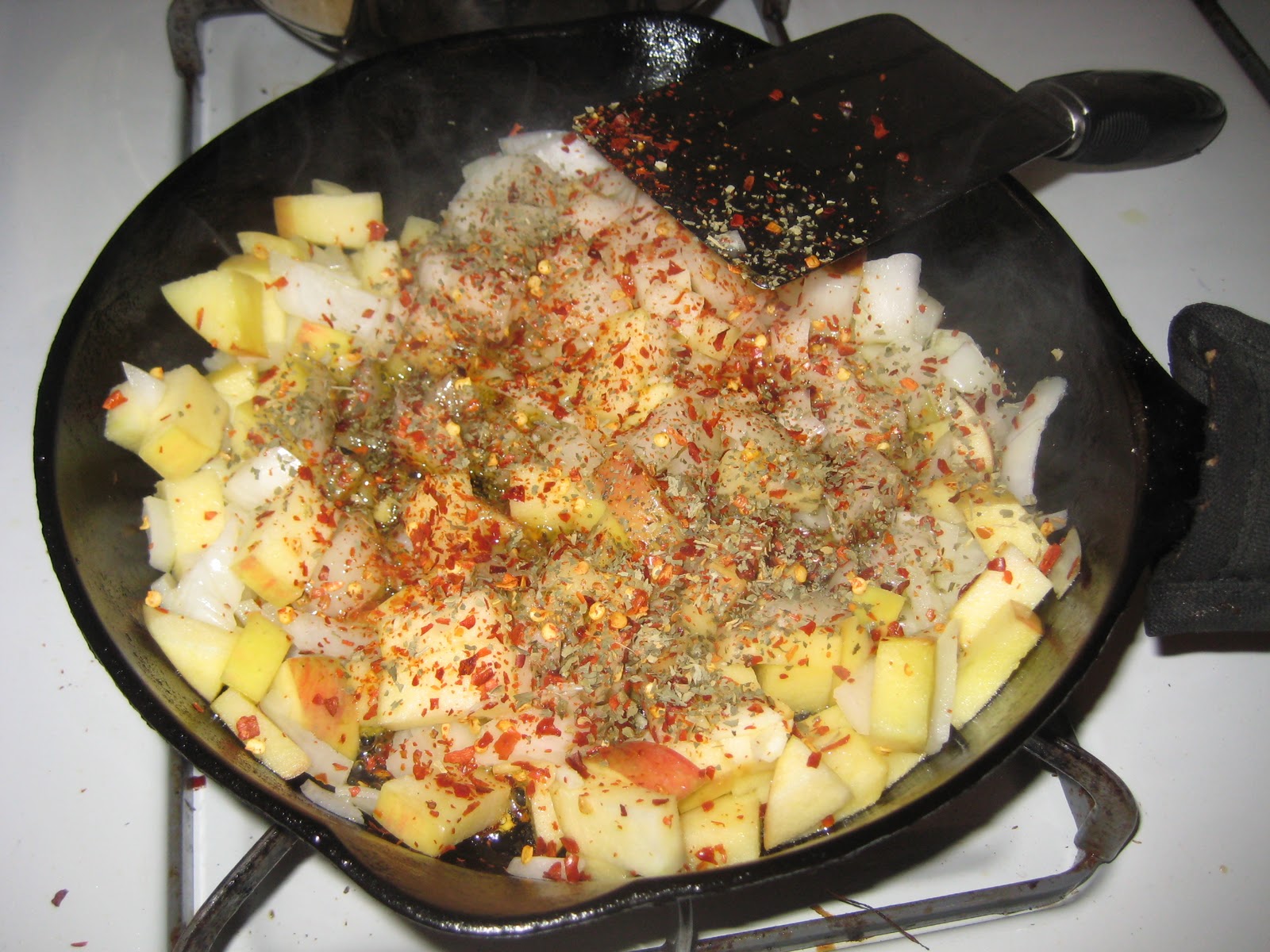


4. Return the saucepan with the onion to medium-high heat. Toss in three-quarters of the radicchio and stir gently until just wilted, about two minutes; season with 1/2 teaspoon salt or to taste. To serve, divide the dumplings and sauce among four bowls and top with the remaining radicchio and parsley.

I think that this recipe could have used some more spices and/or herbs in the dumplings (to satisfy my Indian taste buds), but I also appreciated the simplicity of tastes with the NYTimes recipe.
-----------------------------------------------------------------------------------------------
2) Roasted Vegetable Galette with Olives
Crust:
1 1/4 cups all-purpose flour
1 cup whole-wheat pastry flour
2 teaspoons baking powder
1 teaspoon sugar
1/2 teaspoon salt (could definitely use more salt)
1/3 cup water (needed a few splashes more than this to make the dough come together)
1/4 cup extra-virgin olive oil
1/2 cup finely chopped pitted Kalamata olives
-----------------------------------
Filling:
1 1/2 cups diced
1 1/2 cups diced peeled butternut squash (1/2 medium)
1 cup diced peeled beet (1 medium) I used both red beets and golden beets
2 tablespoons extra-virgin olive oil, divided (definitely used more than this)
2 teaspoons chopped fresh rosemary or 1/2 teaspoon dried (didn't have this and so I think I used some oregano instead, although you could also use sage, thyme, ginger, lavender, black pepper or paprika, I'd say)
You can definitely add in or substitute in various kinds of potatoes, peppers or squashes. Express yourself through your choices.
Preparation
1. To prepare crust: Combine all-purpose flour, whole-wheat flour, baking powder, sugar and salt
2. Press the dough into a disk; if it seems dry, add a little more water. Wrap in plastic wrap and refrigerate for 30 minutes or longer. The unbaked crust will keep, well wrapped, in the refrigerator for up to 2 days.
3. Meanwhile, preheat oven to 400 degrees Fahrenheit. Coat a large baking sheet
4.To prepare filling: Combine carrots, parsnips, squash, beet (or whatever else you added or substituted), 1 tablespoon oil, rosemary, salt and pepper in a large bowl; toss to coat. Spread the vegetables on the prepared baking sheet.

6. To assemble galette: Roll the dough into a rough 14-inch circle about 1/4 inch thick. Coat a baking sheet with cooking spray and place the dough on it. Arrange the roasted vegetables on the dough, leaving a 2-inch border all around. Fold the border up and over the filling to form a rim, pleating as you go.


This was so good. Again, I'd add more salt to the crust, and you can also try to add some herbs/spices to the crust.
-------------------------------------------------------------------------------------------------
Alsatian Pear and Apple Kugel
5 tablespoons vegetable oil
2 pounds ripe Bosc pears You can also use D'Anjou or any other pear
an apple or two
2 small onions (about 1/2 pound), peeled and cut into 1-inch dice
Salt to taste
1/2 loaf bread (about 7 ounces), cubed
3/4 cup sugar
8
2 large eggs
1 teaspoon cinnamon
Juice of 1 lemon
Preparation
1. Preheat the oven to 350 degrees. Grease a 9-inch springform pan with 2 tablespoons of the oil.
3. Heat the remaining 3 tablespoons of the oil over a medium-high heat in a skillet. Lightly sauté the onions until they are translucent. Remove from the heat and salt lightly, allowing them to cool slightly.
4. Soak the bread for a few seconds in lukewarm water and squeeze dry. Put in a large bowl, and, using a wooden spoon or spatula, mix with 1/4 cup of the sugar and the

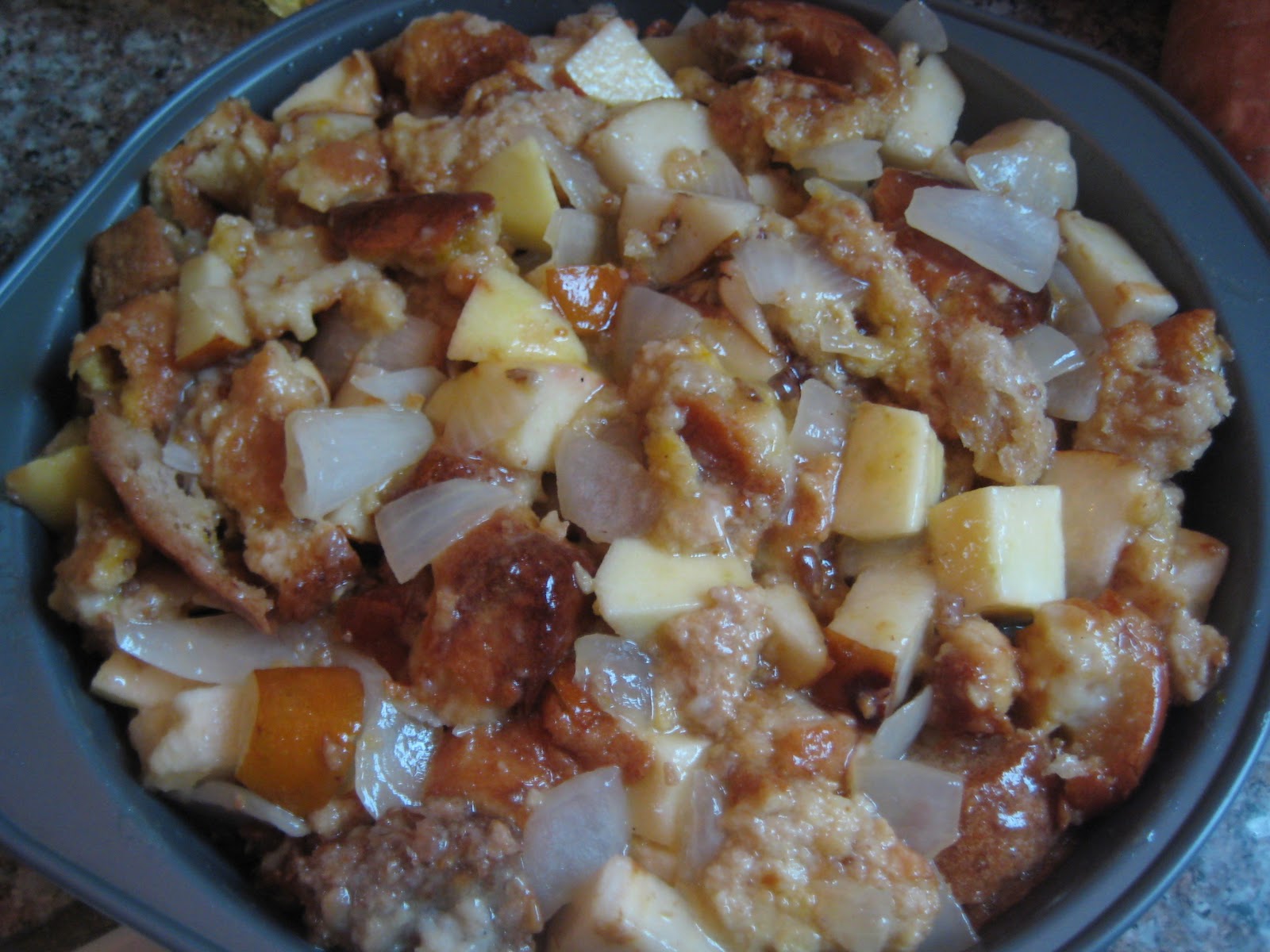
7. Finely grate the remaining pear and stir it into the cooked compote. (I didn't grate the pear, although this would have been better. I thought that the pear would disintegrate, just like apples do when you boil them. I was wrong! No harm done, though)

Yield: 6 to 8 servings.
The onions give this an extremely savoury taste - very different than what we expect cake-like things to be. I loved it.
~Love,
Darshan
Subscribe to:
Posts (Atom)