Tuesday, November 30, 2010

Boycott - strategies and effectiveness

There have been several studies of the effectiveness of boycotts, primarily from the standpoint of consumerism and corporate targets. Pruitt and Friedman (not Milton), in 1986, wrote that, "...consumer boycott announcements appeared to have a highly significant negative effect on the stock prices of the target firms. Not only was there a significant statistical decrease in these prices following the announcements, but the overall market value of the target firms dropped by an average of more than S120 million (this is 1986, mind you) over the two-month post-announcement period."

A more modern academic, Brayden King from Northwestern, has pointed to the effectiveness of targeting a company's image, and not necessarily aiming to affect or decrease sales. His work speaks to the confluence of corporate standing, media attention and declining sales. He finds that a boycott will exert the most influence when there is a lot of media attention on it. However, declining sales have an insignificant bearing on the success of the boycott. The most important thing to target is corporate reputation. A company with a weak reputation is more likely to cede to boycott demands, whereas a company with a strong reputation is not likely to be affected, regardless of sales levels.   

Here is a laundry list of items to think about when organising a successful boycott:
  • Have a clear issue - keep them cognitively simple and emotionally appealing
  • Have a visible target - like...BP! Or not...??
  • Have clear alternatives to the boycotted products - when the Rainforest Action Network boycotted Burger King because of their "rainforest beef," people not only boycotted Burger King, but supported their competitors McDonald's and Wendy's. (I know, it's still sad.)
  • Make sure the violations are visible - Violations are visible in our kitchens, sidewalks and countrysides, and on highways. Check!
  • Have an organised effort - although many personal boycotts can have the effect of an organised one
Here is where I think my personal cultural boycott of trash rates with the laundry list. I think the issue is pretty clear, as I have delineated over the past eight months with pictures, guest bloggers, anecdotes and ethical and philosophical reasons. My targets are "consumerism" and "culture." Hmmm, these seem incredibly vague. Maybe I need to work on the visibility of the target. Since trash has been raised into consciousness, it is clearly visible to me. Although it is clearly visible to other people as well, they are desensitised to it. I have found incredible success in just talking to people, no statistics, no facts. Everyone knows trash. As I have mentioned in several posts (here, here, here), the alternative is to make use of what we have already - I am still alive, and I am still happy. I am still waiting to hear from people about their no-trash stories.

--------
What does a pile of plastic bottles from just one section (of about 33) of a UM American football game look like?
 but Samantha is super cute.


Monday, November 29, 2010

Boycott - different flavours and kinds

(Today marks the start of month nine in my project.)

Boycotts can have multiple targets and have a spectrum of instigators. According to Boycott City, a primary boycott is one in which people or employees boycott a company or employers by not providing their services to it, or not buying their products. Examples of primary boycotts would include the boycott of Whole Foods after its CEO publicly opposed "ObamaCare," or the boycott of BP after the Macondo well blowout. A secondary boycott is one in which employees, labourers, or people try to persuade other entities to join a boycott against their target, or when people target the suppliers or contractors providing services to a target. Examples include the secondary boycott of Israel by the Arab League and the United Farm Workers boycotting grocery store chains in their effort to affect California agribusinesses.

During dinner last night, Krista observed that the targets for boycotts have changed over time. It seems like boycotts nowadays focus on particular businesses or corporations, when in the past, government policies were also part of the mix (the Stamp Act of 1765, Gandhi's boycott of British-made textiles). (I wonder if people, i.e. Tea Partiers, will be boycotting hospitals and medical providers in opposition to ObamaCare.) In today's day and age, it seems like people's purchasing power is what is used to make a point, either by patronising other businesses, or by withholding purchasing entirely.

It seems to me that not consuming at all and not creating trash is more of a cultural boycott. I will write more about the effectiveness of boycotts and examples of famous boycotts next.

Sunday, November 28, 2010

Boycott - what is it?

During the Graham Fellows discussion from last week, several important and thoughtful questions were raised about what constitutes political consumption. As I mentioned in a previous post, the fact that I choose not to create trash, and consequently not consume products is a political consumption choice, under Ethan's definition of political consumption (not only having in mind your immediate family and friends when making a consumption choice, but also people [and I would add creatures, nature, ecosystems, land, water, air, rocks, etc.] outside of your immediacy.). But the fact that I am not creating trash and consequently not consuming makes me think that I am boycotting trash and consumption. Over the next week or two, I will be writing a series of posts on boycotts about their history, types, effectiveness, and also examples of famous boycotts and how my project fits into this framework. Today, a little history lesson of what a 'boycott' is.

According to the Oxford English Dictionary, the word 'boycott' was first used in 1880 in The Times ('They also do not feel warranted in regarding the threat of ‘Boycott’ as one which comes within the Act.') and in 1885 in the Pall Mall Gazette ('Those who have continued to hire Chinese labour and patronize the same since the Boycott.'). Although the word was first used in the 19th century, I am sure that boycotts have been taking place for centuries (anyone want to find out when the oldest recorded boycott took place?). The word comes from the name of Captain Charles Boycott.

"Many British absentee landowners in late 19th century Ireland took advantage of famine conditions in Ireland to evict tenants from their property and to lower wages for field work. One of the worst offenders was Captain Charles Boycott (1832-1897), estate manager of the Irish lands of the British Third Earl of Erne. In 1880, Boycott evicted undesirable tenants from the Earl's estates and paid laborers only half the day wage for field work. An American journalist in Ireland and an Irish priest came up with a fitting word to describe the Irish Land League's tactic of encouraging the peasantry to stop working and producing for oppressive landlords, coining the term "boycotting." Irish peasants "boycotted" the estates of absentee Earl of Erne, forcing Charles Boycott to harvest the crops. The boycott was extended further: no merchant would service the Boycott family, and their servants disappeared. This collective social and economic ostracism forced Boycott to stop his abusive tactics.


The example of the Irish Land League and the rise of organized labor in the United States encouraged the use of boycotts as never before. Hitherto the most famous "boycott" in the U.S., before the word was invented, was in 1765, to protest the Stamp Act. As a result, Parliament repealed the act."


Next time, I will write a bit about types of boycotts.


I am trying to boycott trash and consumption.

Friday, November 26, 2010

A no-trash thanksgiving meal

Here is a post I just wrote for my dear friend Samantha's blog. She is trying to live the year solely on local foods, a low carbon diet. She is thoughtful, intelligent, beautiful and creative. Check out her blog to see what she has been cooking so far.
-------------------------------------

I wanted to share some recipes with you this Thanksgiving and to tell you how much I enjoy cooking, especially for and with other people I cherish. Samantha and I made miso soup for breakfast the other day, on a misty weekend morning, and it was a beautiful morning indeed. I feel like cooking can be a very intimate experience, especially because taste and smell are so primal, and also because you want to make sure that the people you are cooking for enjoy what you've made for them. Food for me is primarily about sharing. At the same time, as students, it is easy to forget that food can taste good, and it doesn't need to be elaborate. In any case, just like Samantha, I take food seriously.

I come from a family of people that love to eat and cook - my parents and sister are amazing cooks. I have learned much of what I know from them. Also, being Indian, cooking is something I tend to feel out - recipes serve only as a baseline (except in baking, when proportions really do matter for things like developing the right amount of gluten in bread dough or fluffiness of muffins). Proportions are tinkered with. If you asked me how many teaspoons of turmeric I add to a pot of fried okra, I honestly couldn't tell you. Cooking can and should be creative - we all have different tastes, and it is fun to explore and expand your own tastes as well. Also, I think that it is important to imagine what things taste like - this will allow you cook in your mind, and make changes that you think will make things different or suit your tastes.

Here are some things I made for my friends (and myself!) this Thanksgiving. I found a great list of Thanksgiving recipes on Well's Vegetarian Thanksgiving on the New York Times website. All of these recipes were made trash-free, too! Here's what I made, and my thoughts on them. The NYTimes website calls for what is in black, and any changes/substitutions/additions I made are in green or the NYTimes ingredient is struck through:

1) Pumpkin dumplings (with my own addition of onion apple topping)


1 15-ounce can pure pumpkin puree (I had a can of this from a year ago, before I started my no-trash project, and so I used it. You can easily make your own pumpkin puree by peeling a pie pumpkin, steaming it, and then blending it)
2 large eggs, lightly beaten
1 cup store-bought gluten-free flour blend (I used flour with gluten)
Salt
2 tablespoons extra-virgin olive oil (Don't be shy - you can definitely use more oil than this. I love oil.)
1 medium onion, finely chopped
1/4 teaspoon crushed red pepper flakes
1 small head radicchio, sliced into 1/4-inch strips (about 2 cups)
2 tablespoons chopped fresh flat-leaf parsley (I used dried parsley)
Two apples - they can be tart or sweet...whatever you'd like! You can also use pears.

Preparation
1. Bring a large pot of salted water to a boil. In a large bowl, combine the pumpkin puree, eggs, flour and 1 teaspoon salt to make the dough.
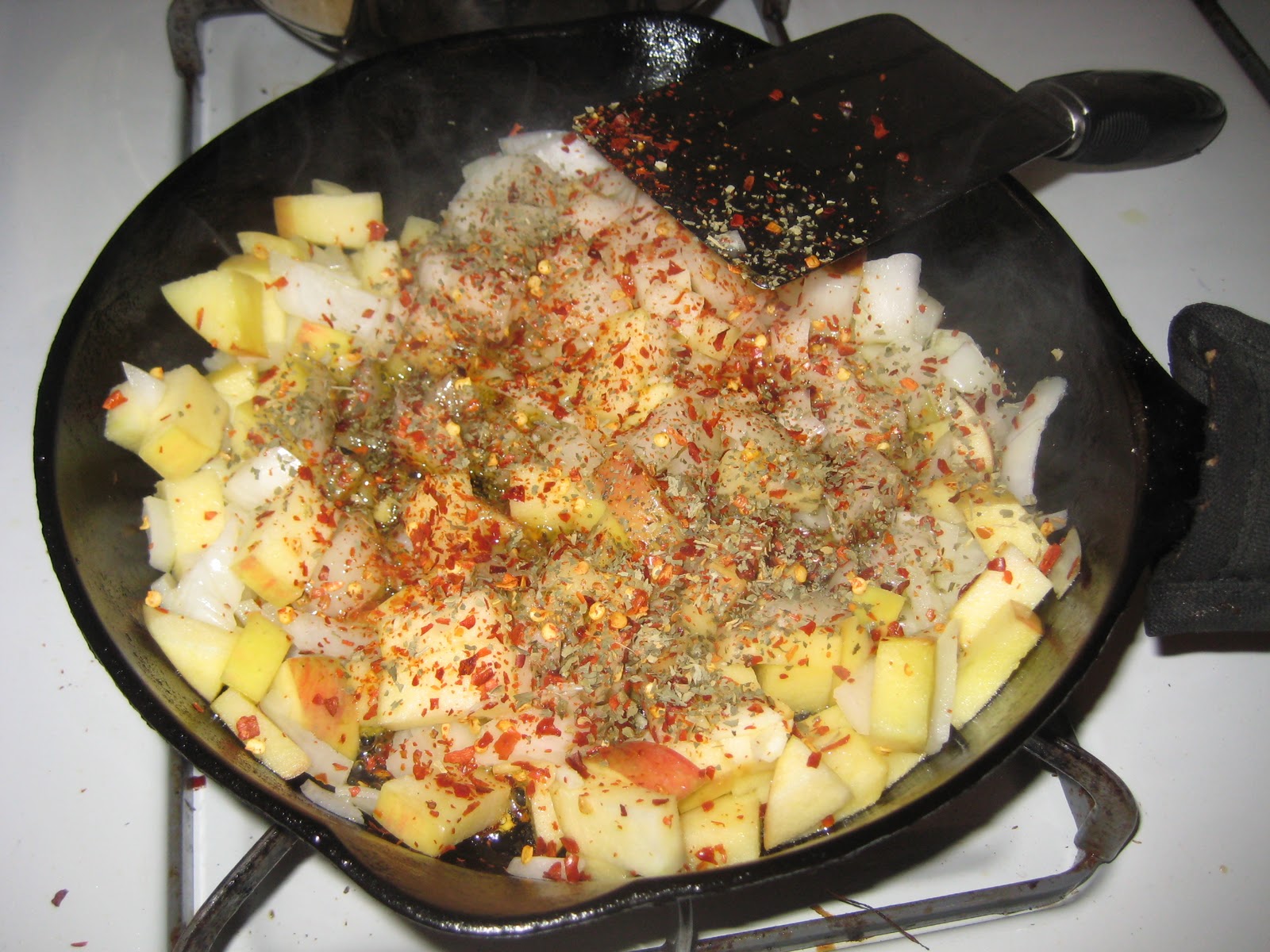
2. In a large saucepan, heat the olive oil over medium heat. Add the onion and red pepper flakes and cook until softened, about five minutes; remove from the heat and set aside. I added apples to this to give it an added fall flavour. 
 
3. When the water comes to a boil, use a teaspoon to scoop up the dough and form a dumpling, then carefully slide the dumpling off the spoon and into the boiling water. Continue forming dumplings until half the dough is used. Cook until the dumplings float, then simmer for about two minutes; remove with a slotted spoon and add to the saucepan with the onion. Repeat with the remaining dumpling dough. Don't worry if the dumplings break slightly and make the water murky. That is totally fine!
4. Return the saucepan with the onion to medium-high heat. Toss in three-quarters of the radicchio and stir gently until just wilted, about two minutes; season with 1/2 teaspoon salt or to taste. To serve, divide the dumplings and sauce among four bowls and top with the remaining radicchio and parsley.
Yield: Serves 4.

I think that this recipe could have used some more spices and/or herbs in the dumplings (to satisfy my Indian taste buds), but I also appreciated the simplicity of tastes with the NYTimes recipe.
-----------------------------------------------------------------------------------------------

2) Roasted Vegetable Galette with Olives
Crust:
1 1/4 cups all-purpose flour
1 cup whole-wheat pastry flour
2 teaspoons baking powder
1 teaspoon sugar
1/2 teaspoon salt (could definitely use more salt)
1/3 cup water (needed a few splashes more than this to make the dough come together)
1/4 cup extra-virgin olive oil
1/2 cup finely chopped pitted Kalamata olives
-----------------------------------
Filling:
1 1/2 cups diced peeled carrots (3 medium)
1 1/2 cups diced peeled parsnips (3 medium) I used Daikon radish instead
1 1/2 cups diced peeled butternut squash (1/2 medium)
1 cup diced peeled beet (1 medium) I used both red beets and golden beets
2 tablespoons extra-virgin olive oil, divided (definitely used more than this)
2 teaspoons chopped fresh rosemary or 1/2 teaspoon dried (didn't have this and so I think I used some oregano instead, although you could also use sage, thyme, ginger, lavender, black pepper or paprika, I'd say)
1/2 teaspoon salt, or to taste
Freshly ground pepper to taste
1 head garlic
1 cup crumbled creamy goat cheese (4 ounces), divided (It is hard to find goat cheese without packaging)
1 egg mixed with 1 tablespoon water for glazing
You can definitely add in or substitute in various kinds of potatoes, peppers or squashes. Express yourself through your choices.

Preparation
1. To prepare crust: Combine all-purpose flour, whole-wheat flour, baking powder, sugar and salt in a food processor; pulse several times. Mix water and oil; sprinkle over the dry ingredients and pulse just until blended. Add olives and pulse to mix. (Alternatively, combine dry ingredients in a large bowl. Make a well in the center and add the water-oil mixture, stirring until well blended. Stir in olives.) I did this by hand. When you make doughs, it is important to know what they feel like. I also added a few hand fulls of water to make the dough come together at this point.
2. Press the dough into a disk; if it seems dry, add a little more water. Wrap in plastic wrap and refrigerate for 30 minutes or longer. The unbaked crust will keep, well wrapped, in the refrigerator for up to 2 days.
3. Meanwhile, preheat oven to 400 degrees Fahrenheit. Coat a large baking sheet with cooking spray. Just use some oil to coat the sheet.
4.To prepare filling: Combine carrots, parsnips, squash, beet (or whatever else you added or substituted), 1 tablespoon oil, rosemary, salt and pepper in a large bowl; toss to coat. Spread the vegetables on the prepared baking sheet. Cut the tip off the head of garlic. Set on a square of foil, sprinkle with a tablespoon of water and pinch the edges of the foil together. Place the packet on the baking sheet with the vegetables. Roast, stirring the vegetables every 10 minutes, until they are tender and beginning to brown and the garlic is soft, about 35 minutes. (The garlic may take a little longer.)
5. Transfer the vegetables to a bowl. Unwrap the garlic and let cool slightly. Squeeze the garlic cloves into a small bowl; add the remaining 1 tablespoon oil and mash with a fork. Add the mashed garlic to the roasted vegetables and toss to mix. Add 3/4 cup goat cheese and toss to coat.
6. To assemble galette: Roll the dough into a rough 14-inch circle about 1/4 inch thick. Coat a baking sheet with cooking spray and place the dough on it. Arrange the roasted vegetables on the dough, leaving a 2-inch border all around. Fold the border up and over the filling to form a rim, pleating as you go. Scatter the remaining 1/4 cup goat cheese over the vegetables. Stir egg and water briskly; brush lightly over the crust. (It would make it look nice, the egg glazing, but I totally forgot to do this!)
7. Bake the galette at 400 degrees until the crust is golden, 30 to 35 minutes. Let cool for 10 minutes. Serve warm.
Yield: Makes 8 servings.
This was so good. Again, I'd add more salt to the crust, and you can also try to add some herbs/spices to the crust.
-------------------------------------------------------------------------------------------------
Alsatian Pear and Apple Kugel with Prunes

5 tablespoons vegetable oil
2 pounds ripe Bosc pears You can also use D'Anjou or any other pear
an apple or two
2 small onions (about 1/2 pound), peeled and cut into 1-inch dice
Salt to taste
1/2 loaf bread (about 7 ounces), cubed
3/4 cup sugar
8 tablespoons butter or pareve margarine, melted I just used vegetable oil instead of butter. It is hard to find trash-free butter. And if you notice cake recipes, they are just full of oil!
2 large eggs
2 cups pitted prunes
1 teaspoon cinnamon
Juice of 1 lemon

Preparation
1. Preheat the oven to 350 degrees. Grease a 9-inch springform pan with 2 tablespoons of the oil.
2. Peel the pears and cut all but one of them into 1-inch cubes. Don't peel the pears - their skin is already delicate. I did peel the apple though.
3. Heat the remaining 3 tablespoons of the oil over a medium-high heat in a skillet. Lightly sauté the onions until they are translucent. Remove from the heat and salt lightly, allowing them to cool slightly.
4. Soak the bread for a few seconds in lukewarm water and squeeze dry. Put in a large bowl, and, using a wooden spoon or spatula, mix with 1/4 cup of the sugar and the butter or pareve margarine oil. Stir in the eggs, onions and half of the diced pears, setting aside the remaining pears for the sauce.
5. Pour the batter into the spring form pan and bake for 2 1 hour 40 minutes or so hours.
6. While the kugel is cooking, make the sauce. In a heavy saucepan set over medium-high heat, put 1 cup of water, the remaining 1/2 cup of sugar, the prunes, cinnamon, lemon juice and the remaining diced pears. Cook this compote mixture uncovered for 30 minutes.
7. Finely grate the remaining pear and stir it into the cooked compote. (I didn't grate the pear, although this would have been better. I thought that the pear would disintegrate, just like apples do when you boil them. I was wrong! No harm done, though)
8. When the kugel is done, remove from the oven and set on a rack to cool for about 20 minutes. Unmold from the pan onto a serving platter, and spoon half of the compote over it. Serve the remaining compote on the side.
Yield: 6 to 8 servings.

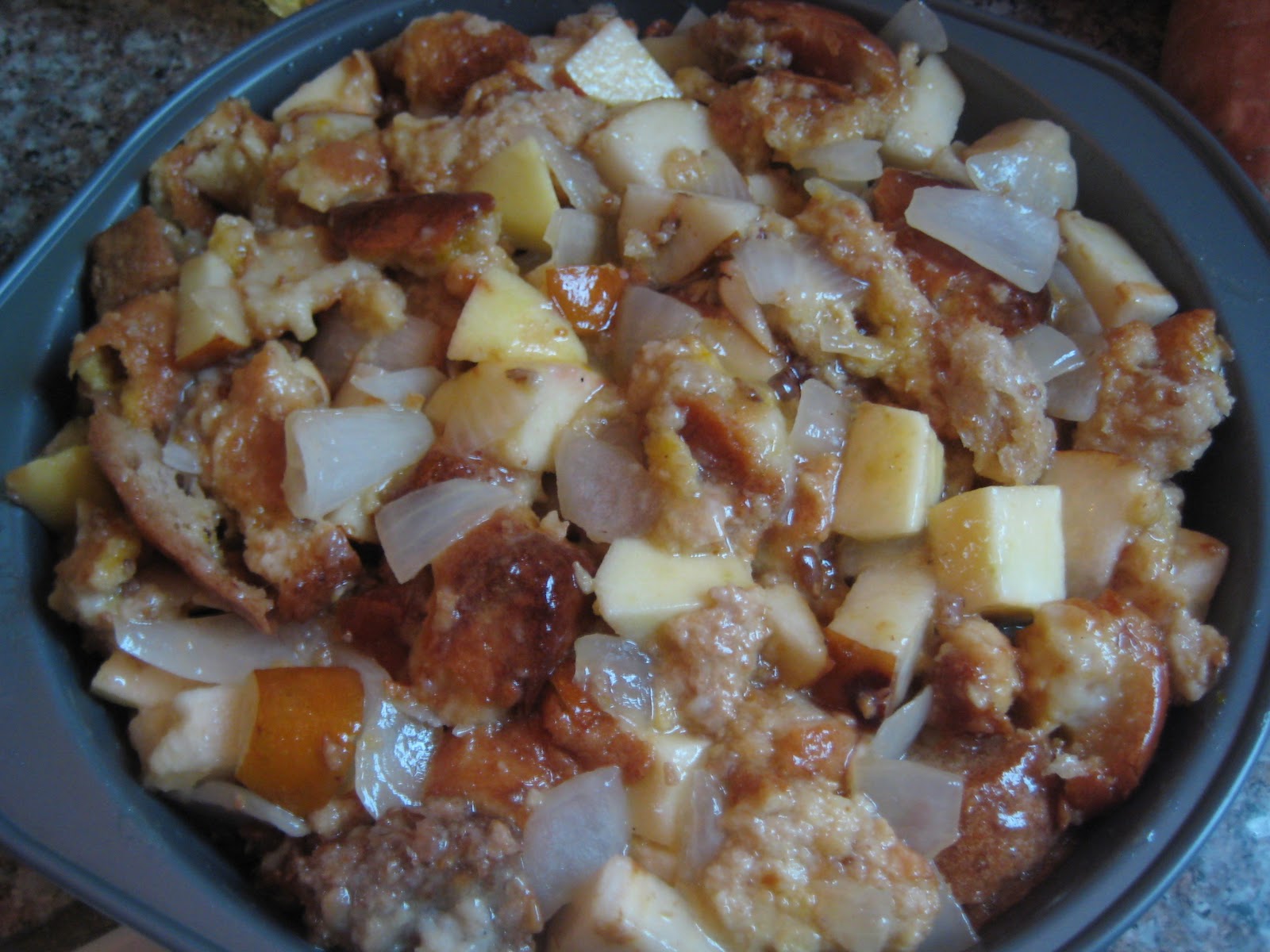
The onions give this an extremely savoury taste - very different than what we expect cake-like things to be. I loved it.

~Love,
Darshan

Wednesday, November 24, 2010

Baking soda made my teeth sensitive (but I still have never had cavities!)

Therefore, I bit the bullet and bought packaged toothpaste. I am sorry Mother Earth.

Tuesday, November 23, 2010

More thoughts on political consumption

At our monthly Graham Fellows meeting today, we further discussed Ethan's dissertation research on political consumption. What Ethan defines as "political consumption" is any consumption that is done with not only yourself or your immediate friends and family in mind, but also people outside of your immediate circle. Examples of political consumption include buying sweat-free clothing to support workers rights, buying organically grown bananas so that labourers don't go sterile by using dibromochloropropane to spray the crop, or going out to eat at a restaurant that is locally owned and run rather than a Denny's. In all of these cases, although the individual consuming their good of choice might as well have done so without taking others into account, the act of thinking beyond themselves is a political choice.

There were several threads of thought that were raised in today's discussion, and all are pertinent to social change, environmental justice, trash and sustainability. I would like to pose these threads as food for thought, not only for myself and for future blog posts, but also for you to think about and send me your thoughts on.
  • Many people consume politically because of the perceived benefits of doing so. These benefits may range from social to environmental and economic, and many times, people will make the same choice for different reasons. For example, some people may choose to buy food from the local farmer's market because they would like to keep their money within a certain locale, while others may go to the farmer's market because the other large grocery chain doesn't have a big selection of organic products. What are motivating factors for political consumption?
  • It is interesting to see how far people are willing to go to act politically. The most explicit example of this is the price of consumption. Say the organic apple costs $1 more than the conventionally grown apple, would you buy it? Some would say yes. How about if it was $2 more expensive? Would you buy it now? How about $5 more expensive? I think this plays a lot into people's need for convenience for doing anything environmentally related ("The recycling bin was too far away, so I just decided to throw away this aluminium can in the garbage."). How much are you willing to spend to do the right thing?
  • People's emotions play a significant role in political consumption. Their choices depend on whether or not they think their choice can make a difference. What communities are people capable of benefiting through their choices?
  • One of the most interesting points that came up today was the effect of consuming politically vs. not consuming at all. I would argue that not consuming at all is a political choice, too. But what is the effectiveness of not consuming vs. consuming politically? Maybe political consumption will drive people, companies and governments to adopt new standards that you think should be the norm. Also, money plays no role in not consuming. It doesn't matter whether you are rich or you are poor, you can choose not to buy. What about boycotts? How effective are they in making political statements?
  • How much does people's disposable income affect whether or not they consume politically? Preliminary results from Ethan's work show that the emotional mechanisms behind political consumption are the same for those with and those without money. 
  • Somewhat tangentially, how does a company's reputation change if they are found to violate social and environmental norms and standards? Apparently, GAP has been in a lot of trouble over the years because many of their suppliers had terrible working conditions. But always, their reputation bounces back...

Monday, November 22, 2010

When is it right to start criticising our ethics?

Now it is Ireland that has to be bailed out by the European Union and the International Monetary Fund. Why does the country of Ireland need to be bailed out? Here's what a BBC article reads:

"Put simply, the seriousness of the situation it finds itself in with regard to the debts of the Irish banks.

As several of the banks have been part-nationalised, most of their massive debt is now actually government debt.

And the great majority of this debt is owed to foreign lenders, which the Irish banks, and therefore the Irish government, simply cannot afford to default on.

This is because the Irish Republic, as a small country, is greatly reliant upon this overseas investment. And to default on their overseas loans would make it very difficult - and far more expensive - for Irish banks to borrow from their foreign counterparts in the future.

More importantly, if Irish banks could not pay back their overseas debt, it would have a knock-on impact on the Republic's overall credit rating.

This would make it more expensive for Dublin to sell government bonds, as it would have to offer a higher rate of interest to more sceptical institutional investors."

.......
House values have fallen by between 50% and 60%, and bad debts - mainly in the form of loans to developers - have built up in the country's main banks. This almost wrecked the institutions, leaving them needing bailing out by the government at a cost of 45bn euros (£39bn; $60.1bn).

This has opened a huge hole in the Irish government's finances - which will see it run a budget deficit equivalent to 32% of GDP this year."

I don't claim to be any sort of expert on banking, international debt and investing and the proportion of GDP that a country's debt is. What I do see, however, is a confluence of events across the world, that although seem disparate to most people, are fundamentally connected through their root cause(s). I think two graphics that are particularly telling are those two below, that I have pulled from here:


What the two graphics together tell me is that most Western countries (including the US) live well beyond their means - services are promised to people that the government takes loans out (from other countries or the IMF or the World Bank) to provide, and these loans are used to create vested interests in those services, ones which people will absolutely not do without. Then, when a problem does arise, say that too many people are starting to default on their mortgage payments, or people's pensions are lost because an airline goes bankrupt, we address the problem by band-aiding it, and addressing it with even more complexity than that which caused the problem in the first place.

Let's take the case of the automobile. We realise that we can use high-energy-density fossil fuels to power internal combustion engines that will propel people from place to place. We don't think of the consequences of sprawl, fluctuating gasoline prices, or greenhouse gas emissions. Now the world is in a bind. We have all of these people that live incredibly far from the places they work and shop, and think of an automobile as an expression of freedom. With "growing" environmental and climate change concerns, there are several options proposed - 1) let's cap carbon dioxide emissions and have companies duke it out to not be the ones paying to pollute, 2) let's tax those entities that pollute based on the amount they pollute, 3) let's find a way to continue driving cars and extract resources from the Earth, just this time let's not let it be fossil fuels. Okay, so we will drive....electric cars and have wind turbines. What do electric cars and wind turbines need? They need batteries and magnets. What are batteries and magnets made of? Lithium, lanthanum, neodymium, and other rare earth elements. Well, the largest deposits of lithium lie in Bolivia (but also in Afghanistan, now!), with an indigenous President who threatens vested interests by instituting land reform (read/listen here and here), and says "Either capitalism dies, or Planet Earth dies." At the same time, the largest deposits of rare earth metals lie in China (here's something for the techies). What will a country like the US do to get access to large reserves of lithium or rare earths? Well, maybe they go to war or assassinate those whose views are markedly different than their own. Also, did you hear about more coal miners stuck underground in New Zealand?

It seems to me that the foundational causes of these problems lie not in that the coal is too deep, or the oil is too far away, or that the rare earths are reserved in a country whose Communism we don't like, but rather in our ethics that compel us to want access to these resources so we can continue to live lives on debt and deficit. We are taking debt at the expense of those people, creatures and ecosystems that will come after we are gone, and we live in a world full of moral, ethical and spiritual deficit.