Showing posts with label Obama. Show all posts

Sunday, March 2, 2014

The Keystone XL pipeline: Youth protests

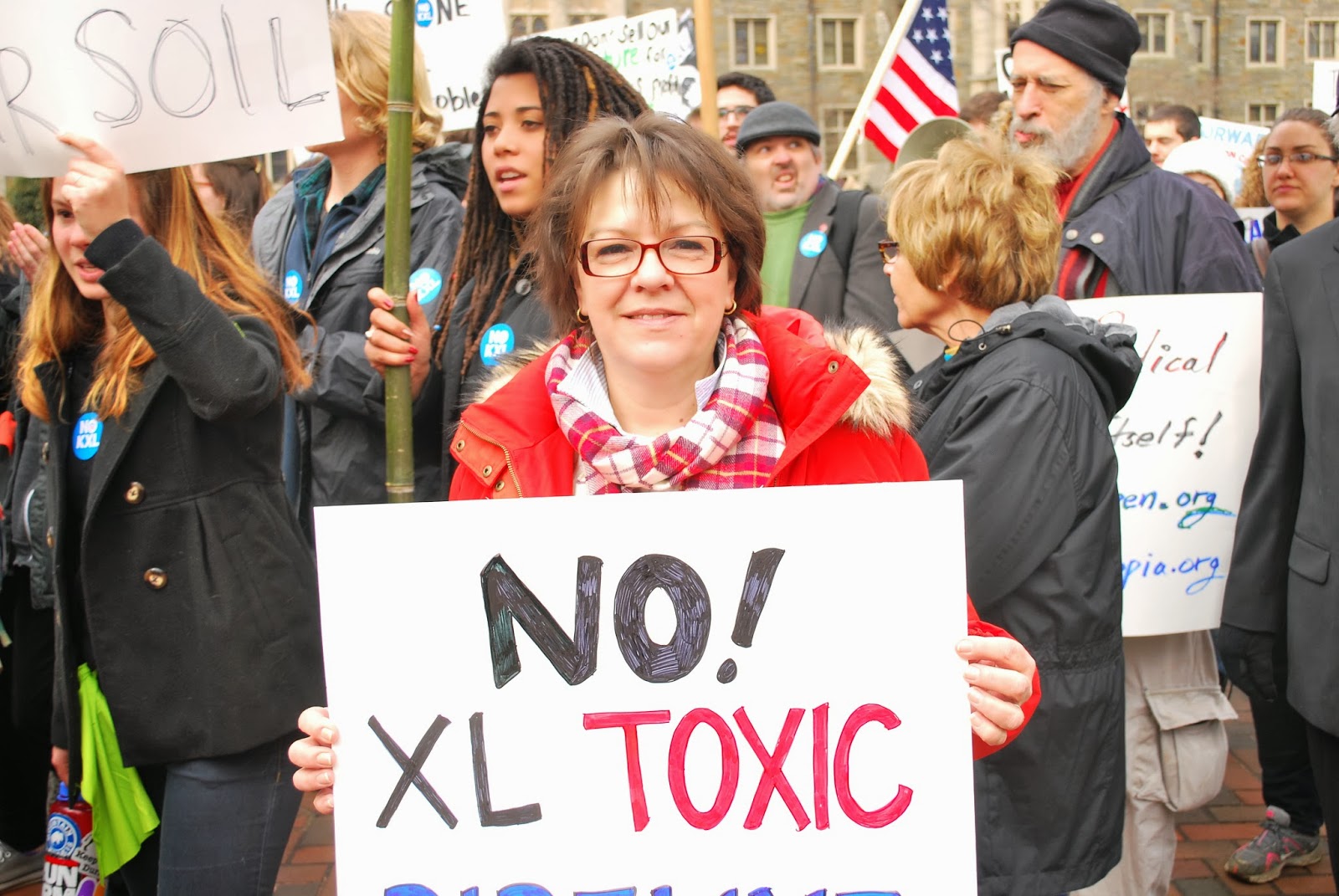
Four days after I moved to Washington, DC, on 28 August, 2014,I was fortunate enough to find my way into the 50th anniversary celebrations of the March on Washington.  While the event was no protest, the goal was clear--direct political messaging, in this case about the confluences of racial and economic injustice.  That day provided my first taste of attending more politically charged events in this city.  Fast forward through a heated anti-drone summit by CODEPINK and a peace vigil in solidarity against the Keystone XL pipeline to today, when several hundred youth activists marched from the Red Square at Georgetown University to The White House to engage in civil disobedience dissent action to send a simple, concise, and extremely political message to President Barack Obama--say no to the construction of the northern leg of the Keystone XL pipeline.

Saying no to the pipeline sets the stage for a course correction on President Obama's "all of the above" energy policy, which is basically this: we can combat the social and ecological dimensions of climate change while still expanding offshore oil drilling, promoting fracking, continuing mountaintop removal, and becoming even bigger trade partners with Canada by importing their ecologically devastating oil.  How such an energy policy can reduce America's dependence on fossil fuels and lighten this culture's burden on the world I do not know, but at the very least saying no to the pipeline is a serious symbolic commitment that activists can gather around to wean this country and the world of toxic and climate change-inducing fossil fuel energy.

Today, I am energized by the spirit of young climate change activists who came in buses and cars from all across the country and who zip-tied themselves to The White House fence and got arrested, with the intention of showing President Obama that the youth cares deeply about the causes and effects of climate change--physical, economic, social, political, ecological.  I thus revive this blog from its hibernation by focusing my next several posts on the Keystone XL pipeline, both to educate myself and to provide you with information about the spectrum of issues that tar sands and the Keystone XL pipeline affects.

My next posts will focus on:
  • the science and engineering behind tar sands extraction, processing, and transport
  • a brief foray into the social implications of tar sands
  • the ecological impacts of tar sands, now and possible
  • arrest, direct action, and the legal issues surrounding arrest for civil disobedience and dissent
  • the climate change movement's relation to other social movements
  • the State Department's environmental impact statement 
Responses to this culture's addiction to oil cannot look at alternatives that continue to bolster the political, economic, and technological paradigm that has us locked in to degrading our Earth to the benefit of a few.  Tar sands represent the very worst things about the risks our government and corporations are willing to take to keep themselves in power.  Just take a look at a very real and ongoing tar sands disaster on the Kalamazoo River--here, here, here and here--in my state of Michigan.  More than three years and close to a billion dollars in clean-up efforts later, who knows when the nightmare will end. 

For now, I leave you with photos I took today during the dissent.


Saturday, September 10, 2011

When push comes to shove, where will you stand?

The hopelessness that pervades environmental issues can be debilitating. Because of the scale of the problems, does the one piece of trash avoided count? How about the car you didn't buy? Does that make a difference? What about the dam that you lobbied against? That surely has an impact, right? Or not? And the civil disobedience in protest against the building of a pipeline that would transport tar sands oil from Alberta, Canada, all the way down to Texas? Does the avoidance of building that make any difference?

Most everyone will tell you no, that these individual things don't matter. What matters really is the policy of action - a systemic change. Andrew Revkin, who has very interesting posts on his environmental blog on the New York Times, Dot Earth, comes down on the side of policy. He says,
But that’s my stance on the project outside of broader contexts. Overall, I think Obama should not stand in the way of the pipeline. While it’s a potent symbol and convenient rallying point for campaigners, it’s a distraction from core issues and opportunities on energy and largely insignificant if your concern is averting a disruptive buildup of carbon dioxide in the atmosphere.
The pipeline plan doesn’t exist in isolation. With the economy in its own tar pit and a presidential election approaching, it’s very much in the national interest for Obama to avoid saddling himself with an unnecessary issue that would be easy for his foes to distort into an Obama anti-jobs position.
This particular pipeline has a good chance of dying on the vine in any case if and when easier, less expensive sources of transportation fuel come online, including domestic oil and natural gas (and there are competing pipeline options and routes).
The greenhouse impact of the oil sands is also far less significant than some claims, particularly given the reality that oil consumption rates are what matters — not the amount of gigatons of carbon sitting in deposits of this sort in the ground.
But this again is a defeatist and elitist attitude towards the environment. Of course, Andrew Revkin and Michael Levi aren't affected by the pipeline directly. Most all of us are unaffected by infrastructural projects - we don't live in the line of the pipeline, and so our mobility, our accessibility, our immediacy isn't what is trampled upon. Here's what one comment in response to his blog says,
I don't see any mention in here of the pipeline being built over the Ogallala Aquifer that provides water to over 30 million people in five states. You may poo-poo the carbon effects, but you can't deny the disaster that will arise with one break in the 1,700 mile pipeline. Further, there is no mention of the destruction of arboreal forest, which covers an area the size of Florida, that the fracking has caused in Alberta. It will continue to grow in size. It is so large it can now be seen from space. Even the oil companies agree it can never be reclaimed. The food and water supplies of indigenous people in N. Alberta is being destroyed. Cancer has increased seven-fold. Caribou meat from a hunt is so full of sores it cannot be eaten.
Revkin says that the pipeline project doesn't exist in isolation [I assume he means it is not a purely "environmental" issues], but rather within the context of President Obama's politics. Of course, if the president wants to do anything, he'll have to wait until his second term, because which president would want to be a one-termer?

Revkin is correct in saying that the pipeline doesn't exist in isolation, but he is not correct in his contextual association. The pipeline in fact exists as a symbol within a wider system of dominance over nature, an unquestioned reliance on technology to solve our problems, of a thirst for energy unabated, of a imaginative and moral deficiency that is debilitating us from doing anything at all. And so we degrade our environment in the name of jobs.

Sure when you view it like that, then protesting against anything doesn't matter at all. But then do we do anything at all? Do we just live in the fear that someone will not get reelected and twiddle our thumbs? Or do we rise to the occasion, and take steps, concrete steps, in our neighbourhoods, communities, cities, to do something, anything?

Individuals and individual actions matter, because they are understood from within the context of their existence, and speak to systemic issues. It is individual efforts that provide tangible examples that provide for reflection, introspection, and consequently systemic change. Mandela, Gandhi, du Toit, Lisitsyn, Kelley, and Pineda are heroes, because they stood their ground, didn't get pushed over, didn't get shoved over, in their efforts to save their homes, their environment, our environment.

Ninety nine is not one hundred.

Monday, July 11, 2011

Illusions

I apologise for not having written for a few days; I haven't had the chance to sit down and write. But I have a few minutes now, and many thoughts running through my head.

I spent the past few days in Manhattan; I arrived at the Port Authority last Thursday, and exited the bus to see the following...


Okay, I'll admit it. Manhattan is fun. There's a lot to do, and a lot to experience and explore. But from the exuberance and ostentation you are surrounded by in New York City, it is easy to forget that the rest of the world doesn't look like this. When you're caught up flashy lights, night clubs, and exotic foods, you wouldn't be able to tell that the world's forests are being demolished, that the climate is changing, that entire villages in Alaska are being moved as we speak because of land loss due to ice melting, that there will be a displacement and migration of hundreds of millions of people within the next few decades. Why wouldn't we be able to tell? We wouldn't be able to tell because the oldest parts of our brains are fixated on the near and short, spatially and temporally. And while we do know now the extent of the damage we've done, and the extent of the damage we should expect, and that our actions and the consequent reactions are what are responsible for this damage, we are not willing to accept this.

Why pick on New York City? Apart from the fact that it is where I was last, New York City represents the very foundation of the behaviour that has led to extreme ecological degradation. While to some New York City represents progress and prosperity, to others it represents greed for money and power, it represents domination of people and of the skies, and it represents a lack of concern for those who have been left behind because of this economy. Yet the image that it has created for itself is immense and immovable in our minds and culture - industrial, "free-market" capitalism will solve all ills (let's just give it a few more years...and a few more...and a few more...), banking and finance and insurance cannot be tinkered with, no matter how morally depraved they may be. But then what are we going to do about sea-level rise and coastal flooding? Are we just going to hope that we build massive barriers to keep the water out of Lower Manhattan (pages 108 and 109 in this Obama Administration report)? Will we continue to think that we need to dominate nature to live in it?

And so going to a one-acre rooftop farm called Brooklyn Grange (although it is in Queens) run by Ben Flanner and others, does give me hope.

It represents a step in a direction, a direction away from here. It represents a gathering of people not to talk about profit, but about community; it represents life, and not the destruction of it, it represents nourishment, and not continued extraction.

New York City is a home to the sort of economic mindset that makes us think of continued "free-market solutions" to climate change or to poverty (again, different manifestations of the same problems). What we've been trained to think is that climate and the environment must conform to the rules of free-market economics, that it is this economy first, then the environment, that this economy is more important than environment. Yet an economy is founded only within the context of an environment, be it local, be it regional, and be it in our minds. What we cannot mess with is our environment. What we must mess with, then, is the economy, this destructive and degrading economy. While carbon taxes or cap-and-trade represent a step, they are not the step. Let's have no illusions about this.

Sunday, February 13, 2011

On change

I have tried to write over the past few weeks about the economy and its relationship to sustainability. My intention with this blog is to try to lay the foundation of understanding problems facing society and the Earth, with the hope that this rudimentary foundation will serve to guide introspection and action. Today's post is about both introspection and action. I want to talk about a word so incredibly overused in the recent past, and a word that is now bubbling to the surface again with the new election cycle - change.

In a recent episode on Being, Krista Tippett spoke with Jon Kabat-Zinn, the founding director of the Stress Reduction Clinic and the Center for Mindfulness in Medicine, Health Care and Society at the University of Massachusetts Medical School. Tippett articulated that we have placed incredible trust in something that we assumed was logical and rational, that is, the economy, which was in fact highly irrational. With the decline of the economy and staggering numbers of foreclosures across the country, people stood shocked that something like this could result from a free-market, deregulated financial sector. In fact, irrationality and unethical practices were paraded with the mask of profit and social good, especially with the mortgage crisis. With a declining economy, our government and financial institutions have tried to "reform" corporate behaviour to a certain extent, with significant backlash from those with vested interests in the economic system staying the way it is. Thus, the notion of change, the locus of President Obama's election campaign, has been highly tempered, such that dominant principles of conduct have gone largely unchanged. In this context, Tippett quoted Sharon Salzberg, a Buddhist scholar and spiritual teacher, who said "Change and suffering are inevitable parts of life."

With ever increasing amounts of ecological degradation, change is at the very heart at the concept of sustainability. A true and radical change is necessarily at the opposite end of the status quo, and any tempering of the concept of sustainability means that meaningful and durable change will always lay beyond arm's reach. Unfortunately, the dominant discourse around sustainability has been around the concept of "sustainable development." In fact, "sustainability" has come to mean "sustainable development," especially within the circles of the governing elite, including the United Nations. The most commonly cited definition of "sustainability," the definition of the Brundtland Commission, is an elitist definition of "sustainable development." This definition in no way questions or changes current structures of governance and societal behaviour, but rather further embeds past behaviour in future visions of the world. Aidan Davison wonderfully critiques the notion of sustainable development, in his book Technology and The Contested Meanings of Sustainability. 

Do you have any thoughts on the concept of change?

Tuesday, February 1, 2011

Short term vs. long term, and "economic" sustainability

If you heard President Obama's State of the Union address last week, you probably heard him talk about "winning the future." His talk was primarily focused around jobs, unemployment, and American "competitiveness." Apart from his mention of jobs needed in the "clean energy" sector, you would have not been able to conclude, however, that there are issues of much greater import that will throw major hurdles in the way of American "competitiveness," notwithstanding water and soil and rare earth metal issues. Obama centered his discussion about the need to get people back to work, and back to producing things and consuming those things, clearly a short term approach to addressing larger scale issues.

If you heard Michigan Governor Rick Snyder's State of the State address the week before that, you would have heard a similar message - a message of jobs and turning Michigan into a "global commerce hub." He also announced that the State would be fully being the Detroit River International Crossing, the second, but publicly-owned bridge to Canada, that will serve to compete with Matty Maroun and his goons at the Detroit International Bridge Company.What this bridge is likely going to do is provide construction jobs in the short term to the State.

Both of these speeches assume that short term jobs are more important than long term vision. What Obama's speech assumes is that we will be able to continually produce and consume, and what Snyder's speech assumes is that making a long term investment, such as a bridge, will make the State of Michigan economically viable, and will hopefully allow the trickling down of money to the poorest of the poor in Southwest Detroit.

One, masterfully trained in capitalism or what have you, might say, that well of course such competitiveness and projects are needed - they provide people with employment, and people employed serve to grow the economy. Such a state is "economically" sustainable under these conditions. But how much longer can we use short term thinking to tackle long term problems such as poverty, inequality, and environmental degradation? These short term approaches, while putting money in the pockets of people today, necessarily puts in peril the ability of future generations of people and animals and plants (and non-living things) to fulfill their needs, or at least puts more pressure on them for them to survive. So in fact, what Obama and Snyder have done here have defined the constraints and bounds within which environmental and social sustainability can be addressed, by constraining the economic aspect of sustainability. As I tried to elaborate yesterday, this is rather the opposite approach that needs to be taken to ensure the long-term viability and resilience of communities, as well as the governments who collect taxes from these communities. How do you transition and balance between short term thinking and long term thinking? Any thoughts?

Saturday, January 22, 2011

On my declining faith in government

I was at the EPA National Vehicle Emissions Testing Facility the other day when it was announced that there would be a new "public-private" partnership between the EPA and Chrysler to develop hydraulic hybrid technology for light duty vehicles such as minivans. The EPA Administrator, Lisa Jackson, was there along with Chrysler Chairman Sergio Marchionne introducing a "new model relationship" between the government and corporations - one in which the government and industry will work hand-in-hand. I was particularly surprised at how many times Jackson called residents of the US "consumers." The newly elected Lieutenant Governor, Brian Calley, was there as well, speaking about how his "family of five consumers" would benefit greatly with this new product. I got the feeling, along with my friends who agreed, that the tone of the government, represented through Jackson and the EPA, was markedly subservient to Chrysler and "other corporate partners." That seemed to rub us the wrong way, given that the EPA is a regulatory agency, whose job it is not to compromise and work with industry, but to set "acceptable" (yes, a loaded word that I will talk about in another post) standards within which industry can operate. Jackson also said the following: "Hydraulic hybrid vehicles represent the cutting edge of fuel-efficiency technology and are one of many approaches we’re taking to save money for drivers, clean up the air we breathe and cut the greenhouse gases that jeopardize our health and prosperity. The EPA and Chrysler are working together to explore the possibilities for making this technology affordable and accessible to drivers everywhere. This partnership is further proof that we can preserve our climate, protect our health and strengthen our economy all at the same time.” (emphasis added by me)

President Obama, in his weekly radio address to the nation, today declared that the United States can "outcompete any other nation on Earth," in what The New York Times called a "pro-growth, pro-trade message that is likely to be at the heart of the State of the Union speech he gives to the Congress on Tuesday." Obama went on the say (with emphases added by me), "We’re living in a new and challenging time, in which technology has made competition easier and fiercer than ever before. Countries around the world are upping their game and giving their workers and companies every advantage possible. But that shouldn’t discourage us, because I know we can win that competition. I know we can outcompete any other nation on earth. We just have to make sure we’re doing everything we can to unlock the productivity of American workers, unleash the ingenuity of American businesses and harness the dynamism of America’s economy." He went on to say, about his trip to Schenectady's GE steam-turbine plant, “This plant is manufacturing steam turbines and generators for a big project in India that resulted from a deal we announced around that trip — a project that’s helping support more than 1,200 manufacturing jobs and more than 400 engineering jobs in Schenectady,” Mr. Obama said. “Good jobs at good wages, producing American products for the world.”

(I will stop short and not talk about new Michigan Governor Rick Snyder's announcement during his State of the State speech this past week about the new bridge between Canada and the US.) I have written at length in other posts about how the government has been as complicit in environmental harm and degradation in the past; these recent announcements do not change my viewpoint, but rather lend evidence that indeed, the government is as short-sighted as corporations are. The government views us, people, people with thoughts, emotions and feelings, as consumers. We are viewed as consumers that only do our rightful duty when we consume and produce and grow, not thoughts, emotions and ethics, but physical products whose presence almost inevitably degrades the Earth's capacity to sustain those very governments. We are at a point in time when simplicity of thought and rhetoric and broad brush strokes cannot allow us to comprehend the full impacts of our actions. More fuel-efficient cars do not mean lesser environmental impact. The economy, the way it is currently defined, cannot protect our health and climate if it grows. There may have been a time when we could have used simple equations such as "more = good." Unfortunately, ecology, the environment, people, emotions and spirit cannot be reduced to an equation.