Showing posts with label India. Show all posts

Thursday, March 7, 2013

Places worth caring about


I recently returned from a trip home to India.  These homecomings have been occurring every two to two-and-a-half years, and each time I have been back home over the last nine years, I have traveled to a new part of the country.  I have in time been to Darjeeling and West Bengal, Gangtok and Sikkim, the Golden Triangle (Delhi, Jaipur, and Agra), Goa, and now, Kerala, known more recently due to tourism advertising as “God’s Own Country.”

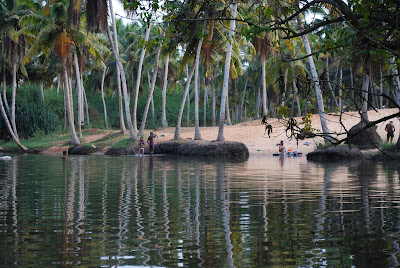
Kerala is truly magnificent.  Lying slender on the western coast of Southern India, it is shaped kind of like Chile.  The coasts are chock full of gorgeous beaches, and the hillside and mountains, just a few kilometers in, are the site of tea plantations that supply 20% of India’s tea production.  But perhaps the most beautiful parts of Kerala, I think, are the backwaters that hug the shoreline.  This is where coconut trees droop over marshy lands and freshwater making its way to the sea.  Here are some examples of what I am talking about.


But as I, and others more productively and prolifically, have written about, there is something that has invaded waters both in Kerala, the Susquehanna River in Pennsylvania, and the Pacific Ocean—trash, and in particular, plastic.  Plastic was abundant in the backwaters, and these are only larger fragments that I found at the surface.  


There has been a supposed campaign for a “plastic-free Kerala.” What this means is very unclear.  Does it mean no plastic at all?  Plastic bags were rare there, but account for just a fraction of all the plastic used and thrown.  What about bottles, like this one?  Here is my dad posing by a "Plastic-Free Zone" sign, with plastic calmly worshipping the posts.  In the backwaters, I actually saw a man clean some sort of plastic off of the propeller of his boat by nonchalantly throwing the plastic back into the water.  


In his TED talk from 2004, James Howard Kunstler, a wonderfully foul-mouthed urban planner and critic of suburban sprawl, spoke about places worth caring about.  He talks about how form and design of places influences people’s behaviour in these places, and how "public spaces should be inspired centers of civic life and the physical manifestation of the common good."  He contrasts public spaces and buildings and homes in America with the tight courtyards you find more commonly in Europe.  Indeed, places worth caring about make us want to protect them, to nurture them, and to make changes to them only so intentionally.  And I think his sentiments translate directly to man and caring for the spaces that nature has created. 


As I wrote about when I returned from India two-and-a-half years ago, does cleanliness mean anything to a country desensitized to public trash heaps?  Indeed, are these places worth caring for?  And if we do care, does that care result in us just hiding away trash as we do in the West, or asking deeper questions such as "Why trash?" or, as Kunstler makes us ask, "Where we are going?"

More on places worth caring for next time.

Saturday, December 3, 2011

Community objects

Homo sapiens sapiens has now come to mean homo faber--man that makes. We have for millennia made objects that have given us advantage over other people, that have asserted our power, that have asserted our "humanity." But as time has progressed, as we have decided that natural rights of freedom and liberty apply to (most) all of us (except those who we exploit so that the privileged can be "free"), we have grown more and more individualistic; libertarianism, while not explicitly stated, is rampant. But freedom has been conflated with doing whatever we want, and "owning" whatever we want. Indeed, we feel it a god-given right for each one of us to have access to all of the material possibilities that have been opened up because of technology. We feel that we must assert our individuality by owning as much as possible, by showing these objects off as symbols of status, by thinking that these objects mean we are "sticking it to the man."--that we do not need to rely on anyone for anything, that all of us can go to Home Depot, and do things ourselves. This individualism has resulted in the loss of human interaction--much of what we do now is mediated through object, rather than through physical contact with other humans. In our quest to own things for ourselves, in our assumption that each one of us is entitled to each one of the possessions we have, we have created an economy based on the collective rape of the Earth to satisfy our individual wants and purported needs.

But this is not the whole story. We have asserted our individuality in some ways, and given it away in another--in ecologically and socially degrading ways. While we assert our independence through materialism, we are watched by Big Brother, we are under constant surveillance, and we live in the fear of speaking our critically against our government and corporations that have constantly exploited this land and this earth to keep themselves alive. Liberty and justice for all are words spoken, but not internalised and acted upon. I wonder then, are there ways in which we can be human, without destroying the planet? How can we build communities and relationships with the Earth that are spatially close-knit, rather than destroy them? May one way be through community objects?

When I say community, I mean community among people, close-knit, within contexts of our local environments. Just like community spaces, like churches, markets, and parks, are there ways in which we can redefine objects such that they are owned by us as a collective, rather than us as individuals? What would that mean for the preservation of objects, and our compulsion to buy more and more? I do not know, but what I do know is that those things and spaces that are common to us all, we generally wish never to be degraded. Scale is important, and objects are for the most part on the human scale. Although we continually trash national parks and landmarks, no one would want a trashed church or a trashed local park. Rather, when the scale of our spaces, and our objects becomes more tractable, we seek to cherish them more and more. The Earth may be too big for each one of us to wrap our minds around. Another plastic bag in the ocean, another computer bought, another flight taken, we think is a drop in the ocean. But a plastic bag seen flailing in our neighbourhood park, an oil spill in our local river, a blighted home we are repulsed by.

I remember while growing up in India, the textbooks that I used, the uniforms I wore, were those that were handed down to me from my elder cousins and friends. Objects were saved and treated kindly, because they could then be bequeathed to the next generation. The textbooks were already marked up and written in, but that was okay, because I still learned from them. The clothes were worn, but that's okay, because it didn't matter how crisply new my shirt was, I still went to school. I feel as if community objects built community. So much of what we do now as individuals is because of a constantly temporary urge for the new. If you were to look back on your life, did it really matter whether you bought that new deck of cards or that new toaster? Or do you think your euchre night would have still been fun with an old deck of cards, your stomach still full and satisfied with a used toaster? And how much better off would the health of our Earth be because of such behaviour? Wendell Berry, in his essay A Statement Against the War in Vietnam writes,
In spite of our constant lip service to the cause of conservation, we continue to live by an economy of destruction and waste, based on extravagance and ostentation rather than need; we can see no reason to be saving, because we cannot imagine the future of the earth or the lives and the needs of those who will inherit the earth after us.

Friday, June 3, 2011

$2/day - The Westernisation of poverty

This post is a continuation of a previous post, which was about the kinds of food poor people have access to, and choose to eat, in different parts of the world. My observations, which are not novel at all, are that the poor in less industrialised countries (such as India and Bangladesh), while eating fewer calories, eat hardier foods like lentils, grains and rice; the poor here are no where close to being overweight or obese. Rather, the poor are thin, wiry and muscular, particularly if they are involved in manual labour. This is in contrast to what the poor in industrialised nations such as the US eat - fast food, junk food and soda. The poor in the US are thus obese and overweight. Michael Pollan, in his piece for The New York Times a few years ago, wrote,

"A few years ago, an obesity researcher at the University of Washington named Adam Drewnowski ventured into the supermarket to solve a mystery. He wanted to figure out why it is that the most reliable predictor of obesity in America today is a person’s wealth. For most of history, after all, the poor have typically suffered from a shortage of calories, not a surfeit. So how is it that today the people with the least amount of money to spend on food are the ones most likely to be overweight?

Drewnowski gave himself a hypothetical dollar to spend, using it to purchase as many calories as he possibly could. He discovered that he could buy the most calories per dollar in the middle aisles of the supermarket, among the towering canyons of processed food and soft drink. (In the typical American supermarket, the fresh foods — dairy, meat, fish and produce — line the perimeter walls, while the imperishable packaged goods dominate the center.) Drewnowski found that a dollar could buy 1,200 calories of cookies or potato chips but only 250 calories of carrots. Looking for something to wash down those chips, he discovered that his dollar bought 875 calories of soda but only 170 calories of orange juice.


As a rule, processed foods are more “energy dense” than fresh foods: they contain less water and fiber but more added fat and sugar, which makes them both less filling and more fattening. These particular calories also happen to be the least healthful ones in the marketplace, which is why we call the foods that contain them “junk.” Drewnowski concluded that the rules of the food game in America are organized in such a way that if you are eating on a budget, the most rational economic strategy is to eat badly — and get fat."

However, my friend Sara, who has been living in Bangladesh for the past few years and working on media, health, and poverty issues, observed, "I have started to see a change however, even in just the past few years in Bangladesh, these high in salt foods, soft drinks, chips etc. are becoming more available especially to those living on $2 a day here. I imagine that we will see a shift, and even a double burden of disease to come not only communicable diseases that you mentioned, along with malnutrition, but also obesity, heart disease and long term health risks in Bangladesh and other eastern societies."

I personally have noticed in India that over time, McDonald's food has become cheaper compared to healthier food options, particularly in places where McDonald's is located, i.e., cities like Mumbai and Delhi. Mumbai, as you might know, is one of the priciest cities in the world. Yet when McDonald's first arrived in India in the early 2000's, prices (of say, a burger there) were definitely much higher than the average price of a sandwich off of the street. But as prices of vegetables and grains have gone up over time, street food has become more expensive, while I've noticed that prices at McDonald's have actually gone down. What worries me, particularly looking at presentations like the one here, is the aggression with which companies like McDonald's want to move into India. And with the little neo-classical economics that I know, I am sure they are out to outcompete, undersell and be the cheapest food option available in places like India and Bangladesh as time goes one. What hasn't changed over time, though, is the healthfulness of such food options.

How this might play out over time I'll leave up to you.

Thursday, February 24, 2011

Objects and materials: On creativity

My posts for the last few days have tried to explore some of the issues surrounding our interactions with objects that populate the world, and the materials they are made out of. Again, I am no expert on these issues, and it would be wonderful if I can get a designer to write about the psychology of objects and materials. But until then, I'll continue to muse and surmise.

There seems to be a massive social learning and association component to materials. It seems like when you are growing up, someone (say, a parent) may tell you, "That is a disposable plate." On asking why so, that person may say, "Because it is plastic." (or whatever...Styrofoam). Maybe the connections between materials and their fate are thus made, never mind the actual potential use of the object after its initial use. The next time you may come across something made of a particular material, you may not feel bad about throwing it in a trash can. And if you don't know otherwise, why would you feel bad? Everyone around you is doing so, and maybe your mum or dad, someone you trust and learn from, tells you that it is okay. What I am trying to say that is maybe the compulsion or tendency to throw something away has more to do with material than it does with the functionality of the object. Maybe...What do you think?

Maybe it is a lack of creativity, though, that plays a significant role in why we feel something can be thrown away, or gotten rid of. I can absolutely see this in the West, having grown up in India, where when I was growing up at least, you would see people make use of objects until they are able to be blown away and disintegrated by the wind (just like how men, me included, will wear underwear until each and every underwear molecule can't retain the properties of a solid...it turns into underwear vapour). Books are continuously handed down from older students to younger ones, as are school uniforms and shoes. Every morning, a "plastic bucket repair man" comes on his bike to your home to see if your plastic buckets need repairing. Once we eat a watermelon, we peel the skin of the watermelon off, thinly, and cut up the white part and curry it and eat it. Old flat breads are given to the cows that stand outside of the temple. There is a creativity of use. I guess that may be an outcome of the heretofore lack of abundance of objects, and it is actually sad to see how India has changed since I've moved to the US.

Creativity is something we lack in almost all aspects of our communities. A reductionist world necessarily devolves and doesn't consider things outside of the well-defined topical areas. A reductionist world can make us think that a bottle can't be used as a cup, because it just isn't a cup. But what exactly are we trying to do? If you're trying to drink something, a bottle can serve as a cup, and a cup serves as a bottle.

Friday, September 3, 2010

Trash in India - Let's import trash!

I had written recently about how Trafigura had illegally dumped tons of petrochemical wastes in Abidjan, the capital of Cote d'Ivoire. Indeed, the so-called "developing nations" have turned into dumping grounds for the so-called "developed nations." Well, here are a few more examples of this, in particular, dealing with India.

The Times of India reported in April about how a port in Tuticorin, Tamil Nadu (a state in India) accepts huge shipments of trash from "developed nations," which contain not only recyclables, but more toxic and hazardous wastes as well. Just as in the case of Trafigura, it is cheaper for companies and nations to "export" their trash (and problems) elsewhere than to deal with them at home, because of "stricter" environmental standards, less corruption or what have you:

"But why are the developed nations dumping their garbage on Indian soil? Simply because shipping municipal waste to India is about four times cheaper than recycling it in their own land. While it costs Rs 12,000 to recycle a tonne of rubbish after segregation in Britain, shipping the rubbish to India costs just about Rs 2,800."

What do you think happens when you "recycle" your electronic goods (your e-waste) in the West? You might think that "socially and environmentally responsible companies" that you bought your products from or send your products to will carefully dismantle the products, make sure heavy elements aren't leaked out, and somehow reform the plastics, semiconductor materials, etc. into "new" products. Not really. A lot of e-waste actually ends up being shipped to "developing nations" where "informal" recycling takes place - computers will be smashed, releasing heavy and toxic elements into the ground, air and water, wires will be removed, and the insulation will be melted off by boiling the wires in pots and pans (that people use to cook). This exposes the wires, which will then be recycled or sold for little value. More sadly, however, is that people, men, children and women, sit over these pots and pans, breathing in the noxious fumes. I listened to one story that said that there are more than 20,000 people in the outskirts of Delhi that deal with such waste - informally and dangerously. All of this is in the name of "progress," "style," and "fashion," constantly "needing to upgrade" what we have and leaving behind things we've used. I will be commenting more on this in my next post.

Wednesday, September 1, 2010

Trash in India - "Cleanliness is next to godliness"

In my school in India, General Education Academy, where I studied from 3rd to 10th, there would always be a quote or a thought at the top of the blackboard, and it changed everyday. These sayings including the usual "Make hay while the sun shines," or "An idle mind is the devil's workshop." There is one saying, however, that is frequently used in India, "Cleanliness is next to godliness."

India is a country of stunning contradictions. Vast slums sit beside beautiful bungalows and high-rise buildings where elites live. Peace of mind, body and soul preaching Hinduism is practiced in cities where people honk their horns constantly even if there is a traffic jam that you can't do anything about. And the most incredible of contradictions - people live and die around keeping their houses clean while they deface the environment and landscape around them...is cleanliness next to godliness?

Most middle class people in India, at least in Mumbai, have someone employed that comes to wash dishes (once for lunch, once for dinner), wash clothes (once a day), and clean the floors (once a day, first sweep the floors, then wipe them down with water). Needless to say, the interiors of homes in India are spotlessly clean. People are so meticulous about this cleanliness, that they organise their days around when the servant comes to clean the home. This stands in stark contrast to how people treat their exterior surroundings. We used to live on the ground floor (or first floor in USA) of our apartment building in Mumbai. Since gravity acts downwards, we would notice people throw things, food, dough, banana skins, water, etc. out of the window. Sometimes the little balls of dough would land on cars with a big thump. I remember this one time when my neighbour walked outside one morning going to work, dressed in a nice sari, and ten feet out, got water, probably a little dirty, dumped on her. When people buy a little pack of chips or an even smaller pack of mouth freshener or tobacco, people thoughtlessly throw the plastic packaging on the side of the road, or in the middle of it, our out the window.

Why is it socially unacceptable to have your house even the slightest bit untidy, but absolutely fine to throw whatever you please on the road, or anywhere outside your home? (This results in pictures that I posted in my previous post.) With 1.2 billion people, it is easy to admit defeat in trying to change people's habits, so maybe people live by the motto "chalta hai." (Chalta hai translates roughly to it's fine, don't worry, just do whatever you want to.) The entire country does run on this attitude, which at times is wonderful, but at times frustrating and dangerous, especially when it comes to waste and trash. You can walk through beautiful parts of cities, towns and villages and still be presented by landscape-scarring trash. I still haven't figured out exactly what drives this attitude, but if you have any thoughts, please let me know...

Tuesday, August 31, 2010

Trash in India

I returned from India yesterday with many thoughts on the country, its people, and where it is headed. I went home to Mumbai, and traveled around Delhi, Agra, Jaipur and Goa. I saw incredibly beautiful sights in Humayun's Tomb, the Taj Mahal, and Gandhiji's home, and at the same time poverty, inequality, and trash...a lot of trash. India is truly a fascinating country - I still have not figured out how it functions, but it does, in incredible ways, and the consequences of how it functions result in copious amounts of "visible" trash as I like to call it. I am pretty sure that the US produces more trash than India, but most of it is invisible.

Over the next few weeks, I will try to develop theses on trash in India. I will try to explain the problem in the context of its attitude, history, culture, demographics, landscape and natural resources. I have seen litter and trash in the most beautiful premises on Earth, and in places that you would hope people would want to keep "clean."

But as I gather and coalesce my thoughts, here are some pictures for you to mull over...

A park at Chandni Chowk in Delhi


On our way to Jama Masjid in Delhi


Outside Grant Road station in Mumbai


A sidewalk in Ghatkopar, Mumbai


A view from the top of Ramniranjan Jhunjhunwala College (my college), Ghatkopar (West), Mumbai