Showing posts with label desensitised. Show all posts

Thursday, March 7, 2013

Places worth caring about


I recently returned from a trip home to India.  These homecomings have been occurring every two to two-and-a-half years, and each time I have been back home over the last nine years, I have traveled to a new part of the country.  I have in time been to Darjeeling and West Bengal, Gangtok and Sikkim, the Golden Triangle (Delhi, Jaipur, and Agra), Goa, and now, Kerala, known more recently due to tourism advertising as “God’s Own Country.”

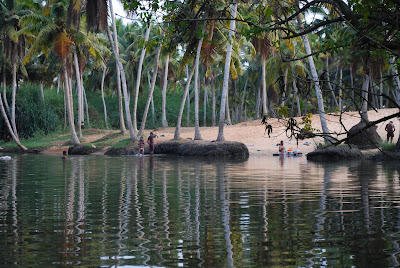
Kerala is truly magnificent.  Lying slender on the western coast of Southern India, it is shaped kind of like Chile.  The coasts are chock full of gorgeous beaches, and the hillside and mountains, just a few kilometers in, are the site of tea plantations that supply 20% of India’s tea production.  But perhaps the most beautiful parts of Kerala, I think, are the backwaters that hug the shoreline.  This is where coconut trees droop over marshy lands and freshwater making its way to the sea.  Here are some examples of what I am talking about.


But as I, and others more productively and prolifically, have written about, there is something that has invaded waters both in Kerala, the Susquehanna River in Pennsylvania, and the Pacific Ocean—trash, and in particular, plastic.  Plastic was abundant in the backwaters, and these are only larger fragments that I found at the surface.  


There has been a supposed campaign for a “plastic-free Kerala.” What this means is very unclear.  Does it mean no plastic at all?  Plastic bags were rare there, but account for just a fraction of all the plastic used and thrown.  What about bottles, like this one?  Here is my dad posing by a "Plastic-Free Zone" sign, with plastic calmly worshipping the posts.  In the backwaters, I actually saw a man clean some sort of plastic off of the propeller of his boat by nonchalantly throwing the plastic back into the water.  


In his TED talk from 2004, James Howard Kunstler, a wonderfully foul-mouthed urban planner and critic of suburban sprawl, spoke about places worth caring about.  He talks about how form and design of places influences people’s behaviour in these places, and how "public spaces should be inspired centers of civic life and the physical manifestation of the common good."  He contrasts public spaces and buildings and homes in America with the tight courtyards you find more commonly in Europe.  Indeed, places worth caring about make us want to protect them, to nurture them, and to make changes to them only so intentionally.  And I think his sentiments translate directly to man and caring for the spaces that nature has created. 


As I wrote about when I returned from India two-and-a-half years ago, does cleanliness mean anything to a country desensitized to public trash heaps?  Indeed, are these places worth caring for?  And if we do care, does that care result in us just hiding away trash as we do in the West, or asking deeper questions such as "Why trash?" or, as Kunstler makes us ask, "Where we are going?"

More on places worth caring for next time.

Wednesday, December 22, 2010

Why not trash Yellowstone?

It is fair to say that most of us think that trash is worthless; trash is indiscriminately thrown “away” and banished. It is rare to see someone adorn spaces with trash, the objects in our lives we choose to discard. Landfills are located in remote areas (both geographically and from those with the most power - instead they are located closest to people who are treated as worthless). Our society have become desensitised to the existence of trash, and have condoned its production for the sole aim of “moving forward.” Fully extending this line of thought, however, leads us down paths our society refuses to consider. When we say trash is worthless to us, that means that the places that the trash ends up are also worthless to us. This means that land, air and water are worthless to us, or can be minimally respected, as long as they can continue to provide services to us unimpeded, or through human intervention and “ingenuity.” A second thought will not be given to a piece of land, any piece of land, as long as industrial agriculture can produce monocultures of crops that can provide people with “food.” As long as it continues to rain, we are fine with trash ending up in our oceans. As long as we can breathe, incinerators can continue to spew toxic chemicals into our air. 

Trash continues to flow as a fluid, down paths of least resistance, ending up degrading the sources of our existence – land, air and water. Let us focus on trash and the land and landfills. Trash continues to fill landfills unabated, with complex politics and policies now surrounding their operation. But what is forgotten, or not considered in these politics and behaviour, is that a landfill is actually a piece of land. This land, unfortunately, has been so "undervalue" that people have chosen to take some of our most "worthless" objects, our trash, and store it there. Some may say that the land we use as landfills wouldn’t have been used any other way. That land would be a "waste" of space; indeed, given our ethic of man over nature, this space must be used to take full advantage of what we as humans have been granted by nature – ample space to spread our influence. Such a space, desolate and uninhabitable in some cases, now can bear scars of our humanity, and become a place that is no longer left untouched. Yet, just because a tract of land is not being used by man, or cannot be used by man does not mean that it is of no value. Now one might ask, "What is the difference between this land, converted to a landfill, and another tract of land, say Yellowstone National Park?" I would say there is no difference in their values as pieces of land that make up this Earth. Each is mystical, each cannot be comprehended fully through science, numbers and technocratic, money-minded thought. The only difference is the difference in human perception through the assigning of monetary value to something purely aesthetic to human senses – we have monetarily valued one piece of land to be much greater than the other. Some may argue that, actually, Yellowstone is invaluable culturally and represents the pinnacle of human conservation of nature, that it represents the grandiosity of nature, its rugged, uncompromising terrain, and the complexity of ecosystems and the geological activity the Earth can support. (Yet this thought has not stopped people from blowing up the tops of beautiful mountains to reach coal laying below the surface; land is "valued" monetarily. If rare earth elements were to be discovered below Yellowstone, Krishna/Allah/Buddha/Science forbid, I am positive the mining industry would line up outside a Congressman’s office seeking approval for mining plans.) But I argue that this land being used as a landfill is as valuable as any other space on Earth, including Yellowstone. A landfill is a piece of land that is made of Earth. It is a piece of land that has been exposed to the weathering elements of rain and wind, that supports complex ecosystems of organisms and the magnificent creations of nature that we barely comprehend. Each piece of land is unlike any other piece of land on Earth, and has been exposed to the forces of nature in a different way than any other place on Earth. 

Now we have two vastly differently valued pieces of land before us - a storied national park, where people from all over the world come to see, to experience and to feel connected to nature, and a landfill, a place valued by humanity so insignificantly that we have no qualms with sending what we value the least, the trash of our culture, to sit there. But if we were to value the uniqueness of each piece of land (as well as each square mile of ocean, each parcel of air), there is no reason that we should send our trash many miles away. Indeed, if we were to produce trash anyway, why not trash Yellowstone, or our backyard?

------------

Here is a post about experiencing nature, and the trash borne of it.
Also, here are two links (1, 2) that Arnab shared with me regarding the trashing of Mt. Everest.