Monday, April 22, 2013
The Overview Effect
Our capacity to switch back and forth between scales of time and place--to understand the global, to acutely observe the local; to learn from the past and act compassionately for the future--is what seems to be in short supply with coming to terms with burgeoning and intricate problems such as climate change and sustainability. We constantly narrow our focus when the problems at hand are large, and we blame structures when it comes to changing what goes on in our households. And so, on this Earth Day, I wanted to share a video with you (which I found posted on my friend's Facebook page a few weeks ago) that helps us make connections of scale, that helps inspire wonder in our minds and activism from the heart. On this Earth day, Overview inspires the aerospace engineer in me, and, more importantly, provides all of us with boundless meaning to the word and the notion of our home, Earth.


Saturday, April 6, 2013
Traveling at home: Annie Clark and her cafe
Since it has been so long since I have written a traveling
at home piece, here are some older thoughts on why I do it.
I feel like the notion of traveling at home falls squarely in line with attempts at reducing trash. When we appreciate what we have, and where we are, we may start looking for beauty, pleasure and wonderment here and now. We don't have to pine to travel to some far out corner of the world, although that would be nice sometimes. We don't have to pine for something from somewhere else, although that would be nice, too. This may seem like some sort of "localism," and maybe it is, but I think it is more. I have not read much about localism but what I hope it means is more than just a patronising of businesses and groups that are close to you. I hope it means that there is a satisfaction with place with a full understanding of what needs to be done environmentally, and consequently socially, to lessen our burden on this planet...I would like to find out what it is that people appreciate about the places they are in, and when and why they decide to call it home
Café Mooset recently reopened in Bloomsburg right next to
Art Space, and right across from the Bloomsburg Theatre Ensemble. I have been going there religiously when in
Bloomsburg, for the quietness of the space, the art on the walls, and the
company of Annie Clark, owner and chef. My
interview was cut short by customers, and so it didn’t come to its tonic, but
here is a part of her life and her thoughts on home.
 |
| Cafe Mooset |
 |
| Art always |
 |
| Annie |
I live about three miles east of Sunbury on Sawmill road, on
the side of a mountain overlooking a beautiful east-west valley. I live on the dark side of the mountain. But, I grew up in the northern part of
Pennsylvania, close to the New York border, in Silver Lake. Silver Lake is nine miles north of Montrose,
and I still call Silver Lake home. We
used to move twice a year from our home in Silver Lake, though, because it
wasn’t weatherized for winter. So, we
moved twice a year. In that way, home
had to be wherever I was, just like for a military family. Fortunately, we moved in the same area, and
so I maintained relations with the same kids in the same school.
How has home changed over time?
It has been developed.
It was once rural, and actually remote, given its proximity to a city
and a town. I just drove there the other
day, and where there were once trees are now houses dotted all around. There used to be a lot of farmland, too, but
the houses used to be clustered in small areas.
The other kids in school used to live five or ten miles away, and so when
I wanted to see them, we had to plan the visits. Nothing was walking distance. The cottages in my area were populated in the
summer, and then no one would be around.
I loved it.
What did you at home?
Well, my brother was a boy.
I was closest to the sons from the next farm, and we would always go to
the water together. I used to do a lot
of stuff on their farm, and as I got older, a horse got involved. My father was not a farmer, but a French
teacher. After teaching, he spent the
rest of his life in Binghamton, working on flight simulators.
How has the environment at home changed over time?
During the late fifties and early sixties, there was a
drought in the area. You couldn’t make
it farming, and so everyone got other jobs, or they would try to farm during
the day, and then have a 3-11 pm night shift job. The farmers of the smaller farms that were
less productive started selling parcels of their land to give way for more
houses. I still remember the dwindling
size of the grass and hay bales. Then
again, everything goes back to the way it was when you stop doing what you
do.
There was a rule about the number of cottages that could be
along the lake, and there was never supposed to be two rows of them along the
lake. Because it was a mountain lake,
all the runoff ended up in the lake, and it began to suffer from
pollution. They fixed it all though, but
I am not sure how.
Saturday, March 30, 2013
Three years, and traveling (at home, too)
While preparing yesterday's post, I remembered how much I loved traveling at home, and so, I decided to talk to Annie, part-owner and manager of Cafe Mooset in downtown Bloomsburg, PA, where my parents live. When she asked me how long I have been writing on this blog, I looked to the bottom right of my computer screen (for some reason left open), and I realised that that day, the 29th of March, 2013, was the three year anniversary of when I started living trash-free, although, as I will write about below, the past few months have been anything but that. (I have recently been saying that I used to live trash-free, because saying otherwise would be like saying I am a vegetarian when I eat non-vegetarian food, even occasionally.) Regardless, the 29th of March still holds weight for me.
When reading my blog posts from the one year and two year anniversaries, I see pictures of the trash and recyclables I was (partly) responsible of introducing into the world. The pictures also make me think about all the choices I made that aren't captured in those pieces of paper, plastic, or metal. I have no record of that for most of this year, mainly because I no longer live in Ann Arbor, and living trash-free is essentially impossible when you are on the road. Since I finished my dissertation in late August, I have been traveling--first, a road trip across the country, primarily out to the western states; then out to the east coast; then back to India.
I cannot say that I have gained any new insights into individual activism and social change over the past year, apart from this: I cannot stress how important it is to be diligent about and attentive towards anything and everything we do. When it comes to trash, for example, I have found at times myself being lax when on the road, knowing that even if I could have saved a small fork or paper bag from being used and immediately discarded, I found myself biting my tongue or not speaking up.
It is quite timely for me to be traveling at home given the amount of traveling I have been doing recently. I consider it a privilege to be able to travel. (I do not take travel lightly.) I have found this country, in particular, to be stunningly gorgeous. Then again, the garden is everywhere, as Barron Wormser writes. I have continued to wonder, though, what it takes to appreciate home, and to have that sense of directed attention towards it as you do when traveling some place new. This is an ongoing project and lesson, and ties into what I am thinking for the year ahead.
Year four will hopefully be influenced by another project that is in the works right now--one which I wrote about a year ago--that I am tentatively calling Dissolved, which is focused on what divides people and opinion, and how we can focus on the things that unite us rather than the things that divide us. Mohammad, my labmate, and I are working on this survey-based project, and I really, really want to get the ball rolling on this.
I would love to have more contributors to this blog, and I thank people for continuing to read it.
Friday, March 29, 2013
"Why isn't the green world enough for us?"
(There is nothing I can add to the poetry of this short essay, The Garden Remains by Baron Wormser in the current issue of Orion, but I have trimmed it for this post. I feel as if he has condensed most of my blog posts into a few short paragraphs, and so, I've provided links to those posts. The essay decorates my last two posts.)
..."There is no shortage of answers--the specter of mortality, sheer restlessness, cupidity and anxiety. To reside in the pagan world of celebrating the harvest god is to acknowledge the difficult truth that life is cyclical rather than linear (1, 2, 3). It is to give primacy to what is in front of us rather than what is behind the scenes. And it is to lay to rest a degree of our inherent uncertainty about this world. The seasons come and go; so do we. That is that. The excitable news of the linear world is so much palaver.
"I tend to think that once human beings entertained notions of the infinite, it was all over. Such a scale had nothing to do with the human race and, in its imaginative potential, everything to do with the human race: it dealt with overwhelming, impossible questions like, Why are we here? and Where are we going? Overwhelming questions tend to call for overwhelming answers. The garden answers those questions, too, but in a very different manner, a much milder one. The garden tells us that we are here as part of all that lives and dies and that where we go is at once plain--back to the earth--and mysterious. We can celebrate both ends.
"Alas, the human race never has been very good at appreciation (1, 2, 3, 4, 5). We're active and forgetful creatures who tend to be glib. To build a culture of appreciation for the finite and reside there may be the largest task facing the human race. It certainly won't be accomplished by being busier and creating more labyrinths of money. Weeding and hoeing are much more important. So is cooking. So is any imaginative endeavor that makes us feel at home on earth.
"When the song "Woodstock" proclaimed that "we've got to get ourselves back to the garden," it wasn't as hippie-foolish as it might have seemed. The backers of the blind certainty that perpetually afflicts human affairs and demands blood sacrifices in the name of ideologies, nation-states, and ethnic hatreds might ponder the peace that resides in that line. We may have left something very crucial behind; yet the good news is that anyone can see the garden any day on earth. It's called grass or tree or fruit or flower.
"Maybe the gift of the green world is more than we can bear. Maybe that is the legend of the garden. Maybe the shame and guilt that go with our exile are more real than any of us can bear. We blew it and continue to blow it. Do we have to? I don't think so, but the image of two stricken, cowering people is what it is. In one unforgettable sense that is the human race.
"Today is beautiful, one of those I-can-feel-everything-growing days. I will go outside and affix pea tendrils to the fence. The tendrils know what to do, but I can help them. I can stand there and linger for long, fulfilling moments and simply take in. It seems the best of all worlds."
~Baron Wormser
The Garden Remains
Orion, March-April 2013
Tuesday, March 12, 2013
More on care and affection
In talking about places worth caring for, Kunstler is basically asking the question, "What do we care about?"
While some people call him a doomer and someone that does not have the "expertise" of an oil economist, there is stil a tremendous amount of sense in what James Howard Kunstler says in his TED talk from 2004 (see previous post). In making places worth caring about, we inherently forgo individual and community actions that degrade place; the built environment guides choices that cherish and nourish place instead. This spirit of place can thus be incredibly empowering.
Care necessarily makes abstract concepts of urban planning and of daily choice more real, tangible, and concrete. Care is not about numbers and statistics (although, I guess, care can be informed by them). Rather than listening to news of ecological doom and gloom here and far away, building (not only materially) and living in places worth caring about actually empowers us to use an emotion so rarely put into action in our daily lives. Today, many of us live in places where we do not know our neighbours or the local ecology, we work in places without sunshine and stare at screens. The massive changes needed in all spheres of our civic and daily life grow from caring.
This care ties in intimately with the affection that Wendell Berry talks about so wonderfully in the 2012 Jefferson Lecture in the Humanities (the highest honor the federal government confers for distinguished intellectual achievement in the humanities) he delivered:
Places worth caring for are absolutely everywhere, and right outside our doorsteps (and inside, too). They don't need to be a thousand square miles big or Glacier National Park.
While some people call him a doomer and someone that does not have the "expertise" of an oil economist, there is stil a tremendous amount of sense in what James Howard Kunstler says in his TED talk from 2004 (see previous post). In making places worth caring about, we inherently forgo individual and community actions that degrade place; the built environment guides choices that cherish and nourish place instead. This spirit of place can thus be incredibly empowering.
Care necessarily makes abstract concepts of urban planning and of daily choice more real, tangible, and concrete. Care is not about numbers and statistics (although, I guess, care can be informed by them). Rather than listening to news of ecological doom and gloom here and far away, building (not only materially) and living in places worth caring about actually empowers us to use an emotion so rarely put into action in our daily lives. Today, many of us live in places where we do not know our neighbours or the local ecology, we work in places without sunshine and stare at screens. The massive changes needed in all spheres of our civic and daily life grow from caring.
This care ties in intimately with the affection that Wendell Berry talks about so wonderfully in the 2012 Jefferson Lecture in the Humanities (the highest honor the federal government confers for distinguished intellectual achievement in the humanities) he delivered:
Obviously there is some risk in making affection the pivot of an argument about economy. The charge will be made that affection is an emotion, merely “subjective,” and therefore that all affections are more or less equal: people may have affection for their children and their automobiles, their neighbors and their weapons. But the risk, I think, is only that affection is personal. If it is not personal, it is nothing; we don’t, at least, have to worry about governmental or corporate affection. And one of the endeavors of human cultures, from the beginning, has been to qualify and direct the influence of emotion. The word “affection” and the terms of value that cluster around it—love, care, sympathy, mercy, forbearance, respect, reverence—have histories and meanings that raise the issue of worth. We should, as our culture has warned us over and over again, give our affection to things that are true, just, and beautiful. When we give affection to things that are destructive, we are wrong. A large machine in a large, toxic, eroded cornfield is not, properly speaking, an object or a sign of affection.(Take the time to read the whole lecture. It is worth absolutely every moment of your time.)
Places worth caring for are absolutely everywhere, and right outside our doorsteps (and inside, too). They don't need to be a thousand square miles big or Glacier National Park.
Thursday, March 7, 2013
Places worth caring about
I recently returned from a trip home to India. These homecomings have been occurring every
two to two-and-a-half years, and each time I have been back home over the last nine
years, I have traveled to a new part of the country. I have in time been to Darjeeling and West
Bengal, Gangtok and Sikkim, the Golden Triangle (Delhi, Jaipur, and Agra), Goa, and
now, Kerala, known more recently due to tourism advertising as “God’s Own
Country.”
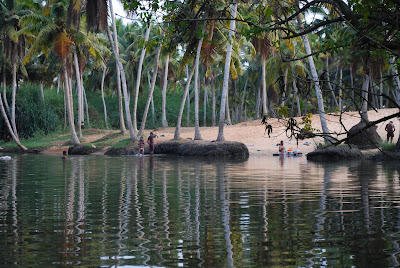
Kerala is truly magnificent.
Lying slender on the western coast of Southern India, it is shaped kind
of like Chile. The coasts are chock full
of gorgeous beaches, and the hillside and mountains, just a few kilometers in,
are the site of tea plantations that supply 20% of India’s tea production. But perhaps the most beautiful parts of
Kerala, I think, are the backwaters that hug the shoreline. This is where coconut trees droop over marshy
lands and freshwater making its way to the sea.
Here are some examples of what I am talking about.


But as I, and others more productively and prolifically,
have written about, there is something that has invaded waters both in Kerala,
the Susquehanna River in Pennsylvania, and the Pacific Ocean—trash, and in
particular, plastic. Plastic was
abundant in the backwaters, and these are only larger fragments that I found at
the surface.


There has been a supposed campaign for a “plastic-free
Kerala.” What this means is very unclear.
Does it mean no plastic at all?
Plastic bags were rare there, but account for just a fraction of all the
plastic used and thrown. What about
bottles, like this one? Here is my dad
posing by a "Plastic-Free Zone" sign, with plastic calmly worshipping the
posts. In the backwaters, I actually saw a man clean some
sort of plastic off of the propeller of his boat by nonchalantly throwing the plastic back
into the water.


In his TED talk from 2004, James Howard Kunstler, a wonderfully
foul-mouthed urban planner and critic of suburban sprawl, spoke about places worth caring about. He talks about how form and design of places
influences people’s behaviour in these places, and how "public spaces should be inspired centers of civic life and the physical manifestation of the common good."
He contrasts public spaces and buildings and homes in America with the tight
courtyards you find more commonly in Europe.
Indeed, places worth caring about make us want to protect them, to nurture
them, and to make changes to them only so intentionally. And I think his sentiments translate directly to man and caring for the spaces that nature has created.
As I wrote about when I returned from India
two-and-a-half years ago, does cleanliness mean anything to a country
desensitized to public trash heaps?
Indeed, are these places worth caring for? And if we do care, does that care result in us just hiding away trash as we do in the West, or asking deeper questions such as "Why trash?" or, as Kunstler makes us ask, "Where we are going?"
More on places worth caring for next time.
More on places worth caring for next time.
Wednesday, January 9, 2013
Back home
I can't say that I am sorry I haven't posted in a while, but I haven't really sat down to write in weeks. There are tons of things that I have been thinking about, particularly the direction of this blog. I welcome your suggestions on issues and topics to explore. But for now, I am going to take the time to think on my way back home, to India. I am not sure I will be able to post anything from there; the blog will be back and up in the end of February, though. Until then, I wish you a happy new year.
Peace.
Peace.
Subscribe to:
Posts (Atom)